
Stacked Markets
What is Stacked Markets? A complete platform overview for 2026
Published May 29, 2026 · By Stacked Markets Research Team
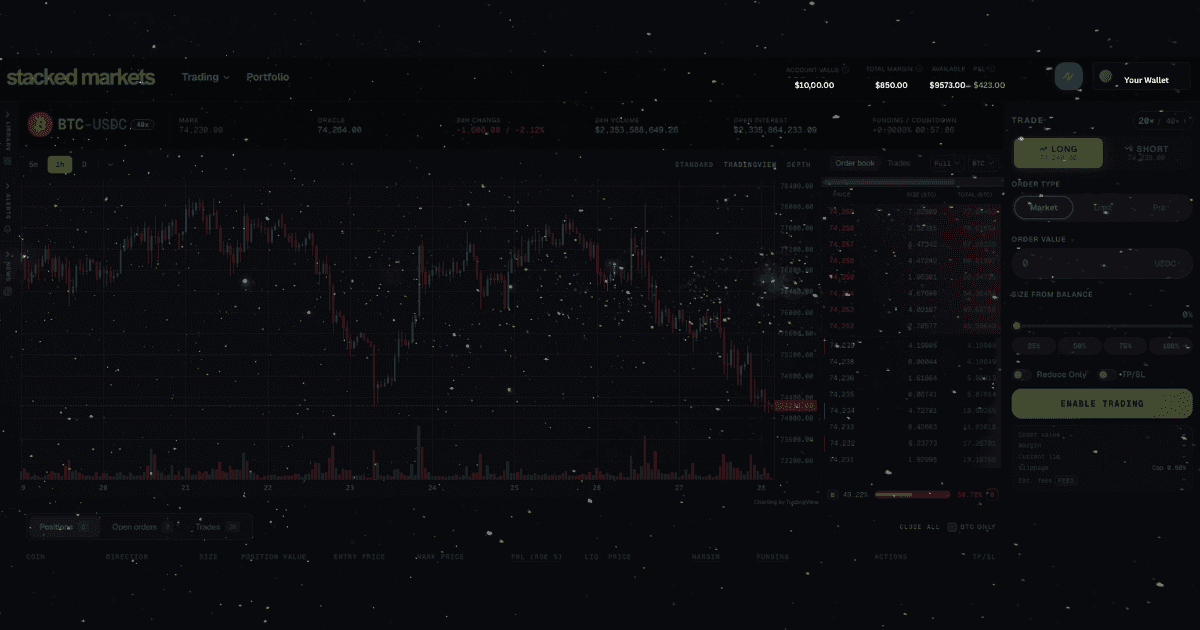
What is Stacked Markets? A complete platform overview for 2026
Contents
- What Stacked Markets is
- How custody works
- The execution workspace
- Order routing: IOC-style limits, not fake market orders
- Signing and approvals
- Stale data guardrails
- Keyboard-first workflows
- What Hyperliquid provides
- Planned features: automation and copy-trading
- How Stacked Markets compares to alternatives
- How to get started
- Risk disclosure
- FAQs
What Stacked Markets is
Stacked Markets is a non-custodial trading terminal for perpetual futures, routing exclusively through Hyperliquid's on-chain central limit order book. You connect an Ethereum wallet, link a signer address, and trade directly from your own keys. Your collateral is never pooled, never held by Stacked Markets, and never leaves your control.
The product is currently live on testnet at testnet.stackedmarkets.com. Mainnet has not launched yet.
The premise is straightforward: professional execution tooling on top of Hyperliquid's CLOB, without surrendering custody.
How custody works
For most perp traders, execution quality and custody have been a forced tradeoff. CEXs offer deep liquidity and fast interfaces, but you deposit into their accounts. Post-FTX, the cost of that tradeoff is no longer theoretical.
Stacked Markets is structured differently. Your collateral sits in your Hyperliquid margin account, not in any pool Stacked Markets controls. The terminal is a routing and interface layer — nothing more. Hyperliquid handles matching, margin, and settlement on-chain. Stacked Markets holds nothing.
When you connect, you link an Ethereum EOA as your signer. Delegated signing is available as an option, but the default is wallet-led. Every order requires an explicit approval from you before anything executes.
The execution workspace
The interface is built around four surfaces: a live order book, a chart, a positions panel, and an order ticket. All four connect directly to Hyperliquid's CLOB. There is no intermediary matching layer between your order and the on-chain book.
Order routing: IOC-style limits, not fake market orders
Most interfaces label an order "market" and bury the mechanics. Stacked Markets routes orders as IOC-style slippage-bounded limit orders, giving you explicit price control at execution. If the market moves outside your slippage tolerance before the order fills, it cancels rather than filling at a worse price.
This is not a cosmetic difference. On a fast-moving perp, slippage can be the gap between a planned entry and a bad fill. Knowing your order type matters.
Signing and approvals
Before any trade executes, a plain-language signing prompt appears in the interface. You see exactly what you are approving before you approve it — no buried confirmations, no one-click flows that obscure what is happening on-chain.
This applies to every order, every time.
Stale data guardrails
The UI surfaces freshness and connection-state indicators in real time. If the data feed goes stale or the connection drops, you see it immediately. Trading on stale prices is a genuine risk in live markets, and the interface is built to surface that rather than paper over it.
Keyboard-first workflows
Keyboard shortcuts are built into the interface from the ground up, not bolted on after the fact. If you trade frequently, cutting the gesture count between decision and execution adds up. The terminal is designed for traders who want speed without sacrificing precision.
What Hyperliquid provides
Stacked Markets is a terminal, not a venue. The liquidity, matching engine, liquidation logic, funding rates, and on-chain settlement all come from Hyperliquid.
That means you access Hyperliquid's shared CLOB liquidity and its fee structure directly. At the standard tier, Hyperliquid charges approximately 0.035 percent taker and offers a 0.01 percent maker rebate. Because Hyperliquid settles everything on its own L1, your funding and PnL are verifiable on-chain.
You are not trading against a separate liquidity pool or a proprietary market maker. You are on the same order book as every other Hyperliquid participant.
Planned features: automation and copy-trading
Two features are in development but not yet live.
Vault-style automation will let you run strategy logic against your own margin account, with hard risk caps and drawdown halts built in. The design includes cancel-all hooks so a runaway strategy can be stopped cleanly.
Copy-trading will let you follow other traders' on-chain positions with per-user notional limits and leverage caps. The follower's collateral stays in their own account throughout — non-custodial by design.
Neither feature is available on testnet yet. The terminal needs to be solid before automation layers on top of it. That sequencing is intentional.
How Stacked Markets compares to alternatives
| Custody model | Order book | Hyperliquid-native | Automation | |
|---|---|---|---|---|
| Stacked Markets | Non-custodial | CLOB (Hyperliquid) | Yes | Planned |
| Hyperliquid native UI | Non-custodial | CLOB (Hyperliquid) | Yes | No |
| dYdX | Non-custodial | CLOB (own L1) | No | No |
| GMX | Non-custodial | AMM pool | No | No |
| Apex Omni | Non-custodial | CLOB (Starknet) | No | Copy-trading |
| WunderTrading | Custodial (CEX keys) | CEX-dependent | No | Yes |
Hyperliquid's native UI is the closest functional overlap. It is non-custodial and runs on the same CLOB. But it offers no customization, no copy-trading, and no automation — you get the default experience and nothing beyond it.
dYdX runs a non-custodial order-book model with over 200 markets, but using it means leaving the Hyperliquid ecosystem entirely. The USDC routing and deposit flow adds meaningful friction.
GMX uses an AMM liquidity pool model. There is no true order book, so execution precision works differently by design.
Apex Omni offers copy-trading but runs on Starknet infrastructure via Bybit. It is not wallet-native for Hyperliquid users and introduces its own onboarding layer.
WunderTrading is a CEX automation layer, not an on-chain execution terminal.
The position Stacked Markets occupies is specific: a Hyperliquid-native terminal with wallet custody, professional execution controls, and automation planned on top. No current product holds all three.
How to get started
Three steps to get going.
- Connect your wallet using the header bar. Email and social login are also available for session recovery.
- Link an Ethereum signer address. Approve the address Hyperliquid should treat as yours. The signing prompt surfaces in plain language so you can review it before confirming.
- Size your position, set leverage, and send. The interface shows your estimated liquidation price and fees before you execute. Halt switches stay one gesture away.
Testnet is live now. You can work through the full execution workflow at testnet.stackedmarkets.com without risking real capital.
Risk disclosure
Perpetual futures are leveraged instruments. You can lose your entire collateral. Stacked Markets does not custody your funds, hold private keys to your main wallet, or provide investment advice. Nothing in this article is an offer to buy or sell any instrument. Always verify whether you are on testnet or mainnet in the product interface before trading. Trade only with capital you can afford to lose.
FAQs
What is Stacked Markets?
Is Stacked Markets live?
Does Stacked Markets hold my funds?
What order types does Stacked Markets use?
How is Stacked Markets different from Hyperliquid's native UI?
What is planned but not yet available?
Who is Stacked Markets built for?
If you want to see how the terminal works before mainnet, testnet is the right place to start. Learn more at stackedmarkets.com.