
Stacked Markets
How to Avoid Crypto Phishing Scams Targeting DEX Traders
Published Jul 4, 2026 · By Stacked Markets Research Team
Contents
- Why DEX traders are high-value targets
- The seven phishing vectors active in 2026
- The nine-rule prevention playbook
- What zero-balance architecture protects - and what it doesn't
- FAQs
DEX traders lost more to phishing and private key compromise in 2026 than to smart contract bugs. That's not a prediction - it's the current reality. According to Chainalysis reporting, phishing and key theft now account for the largest share of DeFi losses, overtaking protocol-level exploits for the first time. The Chainalysis 2026 Crypto Crime Report puts the broader number at USD 17 billion stolen across crypto scams and fraud in 2025 alone - impersonation scams up 1,400% year-over-year, AI-enabled attacks generating 4.5x more per campaign than traditional methods.
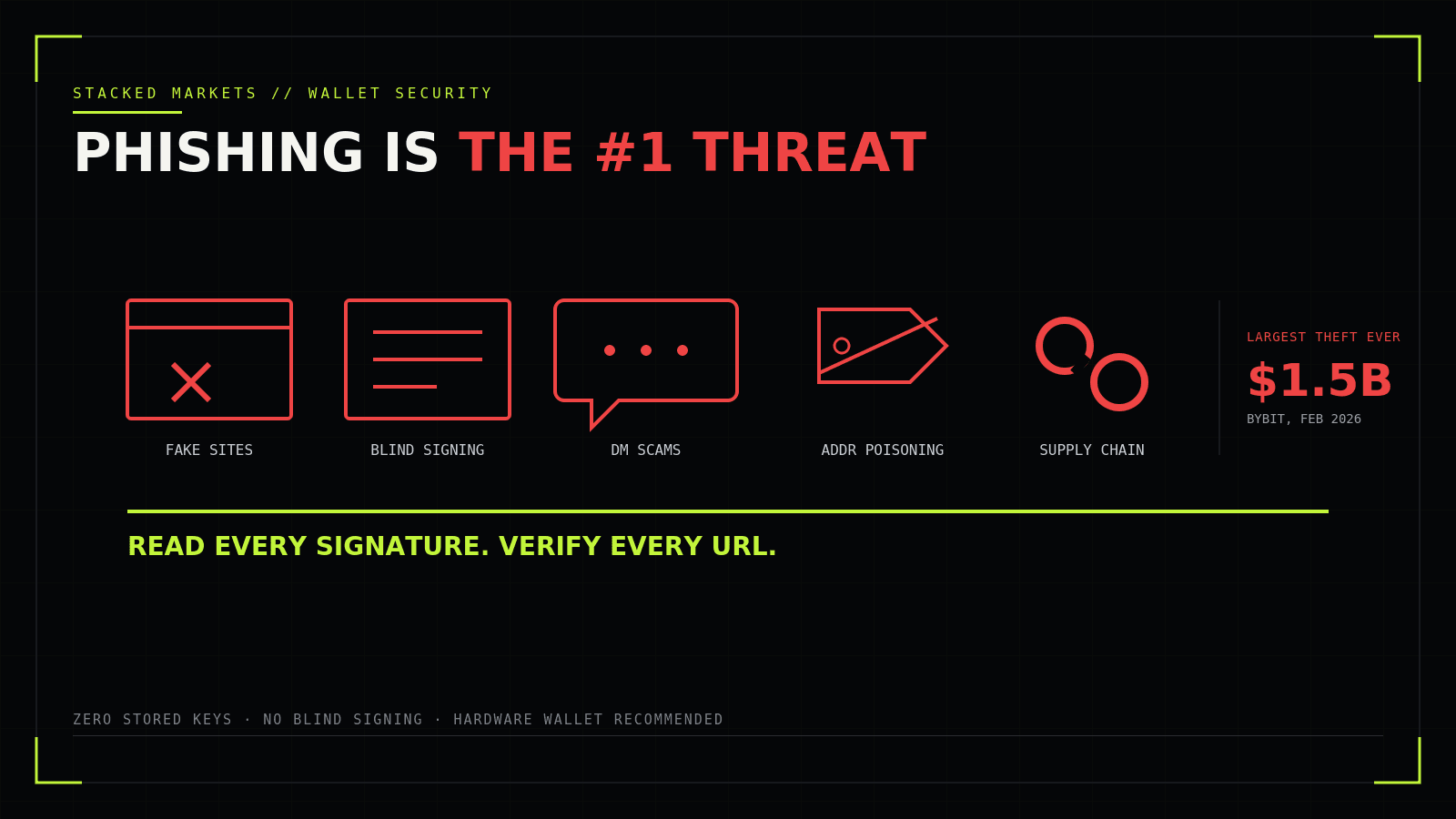
The Bybit hack in February 2026 - USD 1.5 billion, the largest single crypto theft on record - started with social engineering, not a code exploit. The Drift Protocol incident in April 2026, USD 285 million, followed the same pattern: Lazarus Group spent six months building relationships with team members via Discord and LinkedIn before executing. These are not outliers. They are the dominant attack model.
If you self-custody and trade perps on-chain, your threat profile is different from a CEX trader's. There is no password reset, no support line, no freeze mechanism. The attack surface is your wallet, the front-end you connect it to, and every signature you approve. This article covers the seven vectors being used against DEX traders right now and the specific steps that reduce your exposure.
Why DEX traders are high-value targets
Your wallet address is public. Every position you've held, every protocol you've touched, every balance you carry - all of it is on-chain and queryable by anyone.
Industrialised drainer operations now run automated wallet scans to identify high-value targets before making contact. A 2026 audit of compromised wallets identified over 200,000 addresses that had been systematically profiled by drainer services before any attack was initiated. This is not spray-and-pray phishing. It is targeted, intelligence-led social engineering.
Self-custody means there is no intermediary to call. On-chain settlement is final. Approve a malicious transaction and the funds leave immediately and permanently. That finality is exactly what makes DEX traders worth targeting.
The seven phishing vectors active in 2026
1. Fake front-ends and typosquat domains
Pixel-perfect clones of Hyperliquid, Uniswap, and other common DEX interfaces are being hosted on typosquat domains. Google Ads have been used repeatedly to surface these fake sites above organic results, a documented pattern throughout 2025 and into 2026.
You connect your wallet. You see a familiar interface. You approve what looks like an "enable trading" transaction. What you actually signed was an unlimited token approval draining your entire wallet.
The only reliable defence is the URL bar. Bookmark the exact domain of every DEX you use. Never navigate to a protocol via a search engine result. Never click a link in Telegram or Discord to reach a trading interface.
2. Malicious signature requests and blind signing
This is the most dangerous vector for DEX traders. A wallet signature is irreversible the moment it's confirmed.
Attackers present a signing prompt that looks like a standard order approval. Under the hood, it's a permit() or setApprovalForAll() call that authorises the drainer to move every token in your wallet. The MetaMask default display for these calls is not always readable - which is exactly what attackers count on.
eth_sign is the highest-risk signing method because it allows arbitrary data signing with no human-readable display. Reputable terminals use personal_sign with structured, readable prompts. At Stacked Markets, every order signature displays the IOC limit parameters and worst-case fill price before the wallet confirmation popup appears. There is no blind signing in the normal order flow. That is a deliberate design choice.
Rabby Wallet's transaction simulation feature shows you the exact state change a signature will trigger before you confirm. If you see unexpected token approvals in the simulation output, reject immediately.
3. Discord and Telegram compromise
The Drift Protocol attack is the clearest 2026 example: Lazarus Group cultivated relationships with team members over six months via Discord and LinkedIn before the actual exploit. For individual traders, the attack is faster and more direct.
The pattern: you post in a protocol's Discord channel about a failed transaction. Within minutes, a "moderator" or "support" account DMs you with a fix link. The username looks official - zero-width Unicode characters or lookalike glyphs mimic real moderator names. The link leads to a fake front-end.
Other variants include fake airdrop announcements in community channels and fake security alert DMs claiming your wallet has been flagged. The rule is simple: no legitimate protocol moderator or support team ever DMs you first. If someone does, it's a scam. Block and report.
4. AI-generated phishing and deepfake communications
The Chainalysis 2026 report documents AI-enabled scams as 4.5x more profitable than traditional phishing. The reason is specificity. An AI-generated phishing email can include your real wallet address, accurate position details, actual transaction hashes from the blockchain, and communication style that perfectly mimics the protocol you use - because all of that data is public and scrapeable.
Deepfake voice calls are now documented. Attackers clone the voice of a known protocol team member or trading contact and call with an urgent request. The tell is always urgency combined with a request to act via an external link or approve a transaction. Slow down. Verify through a separate channel before doing anything.
5. Fake wallet apps and malicious browser extensions
In February 2026, Trezor impersonation phishing reached a new level: physical letters were mailed to addresses sourced from Ledger's 2020 data breach - 272,000 records - instructing recipients to update their firmware via a fake URL. A breach from years ago is still being used to target hardware wallet owners today.
Malicious MetaMask, Rabby, and Phantom extension forks appear regularly on the Chrome Web Store. They have reviews, look legitimate, and steal keys on first use. Only download wallet software from the official domain. Check the exact publisher name before installing any browser extension. If the publisher domain does not match the official wallet site exactly, do not install it.
6. Address poisoning
The attacker generates a wallet address that shares the first four to six and last four to six characters with an address you use regularly - your Arbitrum bridge address, a CEX deposit address, a frequent counterparty.
They send a small dust transaction to your wallet from the poisoned address, placing it in your transaction history. You copy what you think is the familiar address from history. You send funds to the attacker instead.
This is particularly relevant for Hyperliquid traders withdrawing USDC to Arbitrum, where the same bridge or exchange deposit address gets reused repeatedly. Never copy an address from transaction history. Use saved contacts or ENS names. Verify the full address character-by-character on your hardware wallet screen before confirming any withdrawal.
7. Supply chain attacks on front-end dependencies
The attacker compromises a widely-used npm package or JavaScript library imported by multiple DeFi front-ends - wallet connection libraries like WalletConnect or Web3Modal are documented targets. Malicious code is injected that intercepts wallet signatures at the browser level. You are on a completely legitimate URL. The front-end looks and functions normally. The compromise is invisible.
As an individual trader, your best mitigations are: use a hardware wallet for all non-trivial activity (malicious JavaScript cannot extract private keys from a hardware device), enable Rabby's transaction simulation, and monitor BlockSec Phalcon alerts for active exploits.
Stacked Markets never stores keys server-side. If the front-end were compromised at the dependency level, there are no keys on Stacked's servers to steal. A supply chain attack on the front-end cannot access funds beyond what you've already approved in the current session. Hardware wallet confirmation adds a second layer that malicious code cannot bypass.
The nine-rule prevention playbook
- Bookmark every DEX URL you use. Never navigate via search engine. Never click links in Discord or Telegram to reach a protocol interface.
- Simulate every transaction before signing. Rabby Wallet shows the exact state change a signature will trigger. Unexpected token approvals in the simulation output mean reject immediately.
- Revoke approvals after every session. Use revoke.cash or Etherscan's token approval checker. Old unlimited approvals are the lowest-effort attack surface available to any attacker who later compromises a protocol.
- Hardware wallet for all non-trivial on-chain activity. A malicious front-end cannot extract your private key from a hardware device. The device screen shows what you are actually signing - not what the browser wants you to think you're signing.
- Separate wallets by function. Hot wallet for active small-position trading. Cold wallet for anything substantial. Never connect your cold storage wallet to any DeFi interface.
- No protocol moderator DMs you first. Legitimate support is always in public channels. Any unsolicited DM offering help, an airdrop, or a security warning is a scam. Block and report without engaging.
- Verify extension publishers before installing. The exact developer domain must match the official wallet site. MetaMask's publisher is metamask.io. Any discrepancy, do not install.
- Never rush a signature. Urgency is the attacker's primary tool. A legitimate protocol order will wait 30 seconds for you to read the signing prompt carefully. If something is pressuring you to sign fast, that pressure is the attack.
- Check the full address, not just the first and last characters. Verify on your hardware wallet screen. Address poisoning exploits the habit of partial matching - a habit that's easy to break once you know the attack exists.
What zero-balance architecture protects - and what it doesn't
Non-custodial architecture removes the platform as an attack vector. It does not remove you as one.
Stacked Markets holds zero user balances and zero signing keys. If Stacked's servers were compromised, there is nothing stored there to steal. Your margin sits on Hyperliquid's on-chain protocol - the same protocol that holds approximately USD 7.3 billion in open interest across 150-plus markets as of 2026, with an independent security track record.
What this does not protect against: if you connect your wallet to a spoofed Stacked Markets domain and approve a malicious transaction, you are signing from your own wallet. The architecture protects against platform-level theft. It cannot protect against you approving the wrong thing on the wrong site.
That is not a criticism of non-custodial design. It is an honest description of where the remaining risk sits. The prevention playbook above is what closes that gap. Non-custodial architecture and personal operational security are both required. Neither replaces the other.
Try Stacked Markets on testnet - practice the complete signing flow before going live with real funds.
FAQs
What is the most common phishing attack on DEX traders in 2026?
Fake front-end domains and malicious wallet signature requests are the two most prevalent vectors. Attackers clone DEX interfaces on typosquat domains and use Google Ads to surface them above legitimate results. Traders connect their wallet and approve what appears to be a standard transaction - which is actually an unlimited token approval. The Chainalysis 2026 Crypto Crime Report identifies phishing and private key compromise as the largest category of DeFi losses, ahead of smart contract exploits.
How do I know if a wallet signature request is safe to approve?
Read the full signing prompt before confirming. Legitimate DEX order signatures display specific, human-readable parameters - order type, price, size, worst-case fill. If you see a permit() call, a setApprovalForAll() call, or any request to approve token spending you did not initiate, reject it. Use Rabby Wallet's transaction simulation to see the exact state change before you confirm. Unexpected token approvals in the simulation output are your answer.
Can a phishing attack steal funds from a hardware wallet?
A phishing attack cannot extract the private key from a hardware wallet - the key never leaves the device. However, if you approve a malicious transaction on your hardware wallet because you didn't read the signing prompt carefully, the funds can still be stolen. The hardware wallet displays what you are actually signing on its own screen, independent of what the browser shows. Always verify on the device screen, not the browser.
What is address poisoning and how do I avoid it?
Address poisoning is when an attacker generates a wallet address that closely resembles one you use regularly, then sends a small dust transaction to your wallet from that address. If you copy an address from your transaction history, you may copy the attacker's address instead of the legitimate one. Avoid it by never copying addresses from transaction history. Use saved contacts, ENS names, or verify every character on your hardware wallet screen before confirming.
If I get phished on a DEX, can I recover my funds?
In most cases, no. On-chain transactions are final. There is no customer support team, no chargeback mechanism, and no freeze capability. If you approved a malicious token approval, revoke it immediately using revoke.cash to prevent further drainage - but funds already transferred are gone. Speed matters: if you realise you signed something malicious, revoke the approval before the attacker executes the drain.
How do I report a fake DEX front-end or phishing domain?
Report the domain to Google Safe Browsing via their reporting tool. Report it to the legitimate protocol's official channels so they can warn their community. If the domain is impersonating a specific wallet or protocol, contact that project's security team directly via their official website or GitHub. Phishing domains are sometimes taken down within hours when reported through the right channels.
Is a non-custodial terminal safer from phishing than a CEX?
It depends on the attack type. For platform-level attacks - exchange insolvency, server compromise, internal theft - non-custodial architecture provides a structural advantage because there are no funds to steal at the platform level. For front-end phishing and malicious signature attacks, the risk profile is similar or higher, because approving a malicious transaction on a DEX is irreversible in a way that a CEX transaction often is not. Non-custodial trading shifts the security responsibility to you. That is the correct trade-off for traders who want self-custody - but it requires the operational discipline to match.