
Stacked Markets
Hardware wallets for active traders: what they actually protect (and what they don't)
Published Jul 4, 2026 · By Stacked Markets Research Team
Contents
- How a hardware wallet actually works
- What a hardware wallet protects against
- What a hardware wallet does NOT protect against
- The active trader objection: "hardware wallets slow me down"
- The three-bucket framework
- The agent wallet bridge
- When hardware signing is actually essential for an active trader
- Hardware wallet comparison for active DeFi traders in 2026
- The practical setup for an active on-chain trader
- The honest verdict
- FAQs
Most hardware wallet content is written for people who move funds twice a year. This isn't that. If you're actively trading perpetual futures on-chain, running positions on Hyperliquid, and cycling margin in and out of your wallet, you already know hardware wallets exist. The real question is whether they fit into a workflow that demands fast execution - and if so, exactly where they belong.
The honest answer: a hardware wallet is a vault, not a trading tool. But every serious on-chain trader still needs one. Just not for the reason most people assume.
How a hardware wallet actually works
A hardware wallet stores your private key inside a dedicated chip called a Secure Element. The key never leaves that chip. When you sign a transaction, the signing happens on the device itself - not in your browser, not on your laptop, not anywhere accessible to malware.
The flow: your browser constructs the transaction and sends it to the device. The device displays the details on its own screen. You confirm physically on the device. The signed transaction goes back to the browser for broadcast. Your key was never in the browser. It was never in memory on your machine. It existed only inside the Secure Element during the signing process.
That's the core protection. A compromised browser, a malicious extension, a keylogger running in the background - none of these can extract a key that never arrived on the host machine.
Clear signing vs blind signing
One distinction that matters for DeFi traders: clear signing versus blind signing.
Clear signing means the device decodes the transaction and shows you human-readable details on its screen - "you are approving X token to contract Y" or "you are transferring Z ETH to address 0x...". You see what you're actually approving.
Blind signing means the device shows a hash or raw hex. You're approving something, but you can't read what it is on the device screen. Most hardware wallets have historically defaulted to blind signing for complex smart contract interactions. Newer firmware and app integrations are pushing clear signing further, but coverage across all DeFi protocols is still incomplete.
For active traders, this gap matters. If your device can't decode a complex approval transaction, you're trusting your browser's UI - not your hardware wallet's screen. That's a meaningful distinction.
What a hardware wallet protects against
The threat model is specific: malware on your host machine.
If your laptop has a drainer installed - a malicious extension, a compromised browser plugin, a clipboard hijacker - and you're running a software wallet with a hot key, that malware can intercept your private key or silently replace destination addresses. Hardware wallets break this attack entirely. The signing key never reaches the infected environment.
This isn't theoretical. Malware-based drainer attacks have drained hundreds of millions from DeFi wallets. The vector is almost always the same: a compromised browser extension or a phishing site that tricks the trader into exposing their seed phrase.
Hardware wallets are directly protective against this class of attack. Token Metrics noted in 2026 that hardware wallets still offer the strongest defence against malware, phishing, and exchange failures - because the key isolation is architectural, not behavioural.
What a hardware wallet does NOT protect against
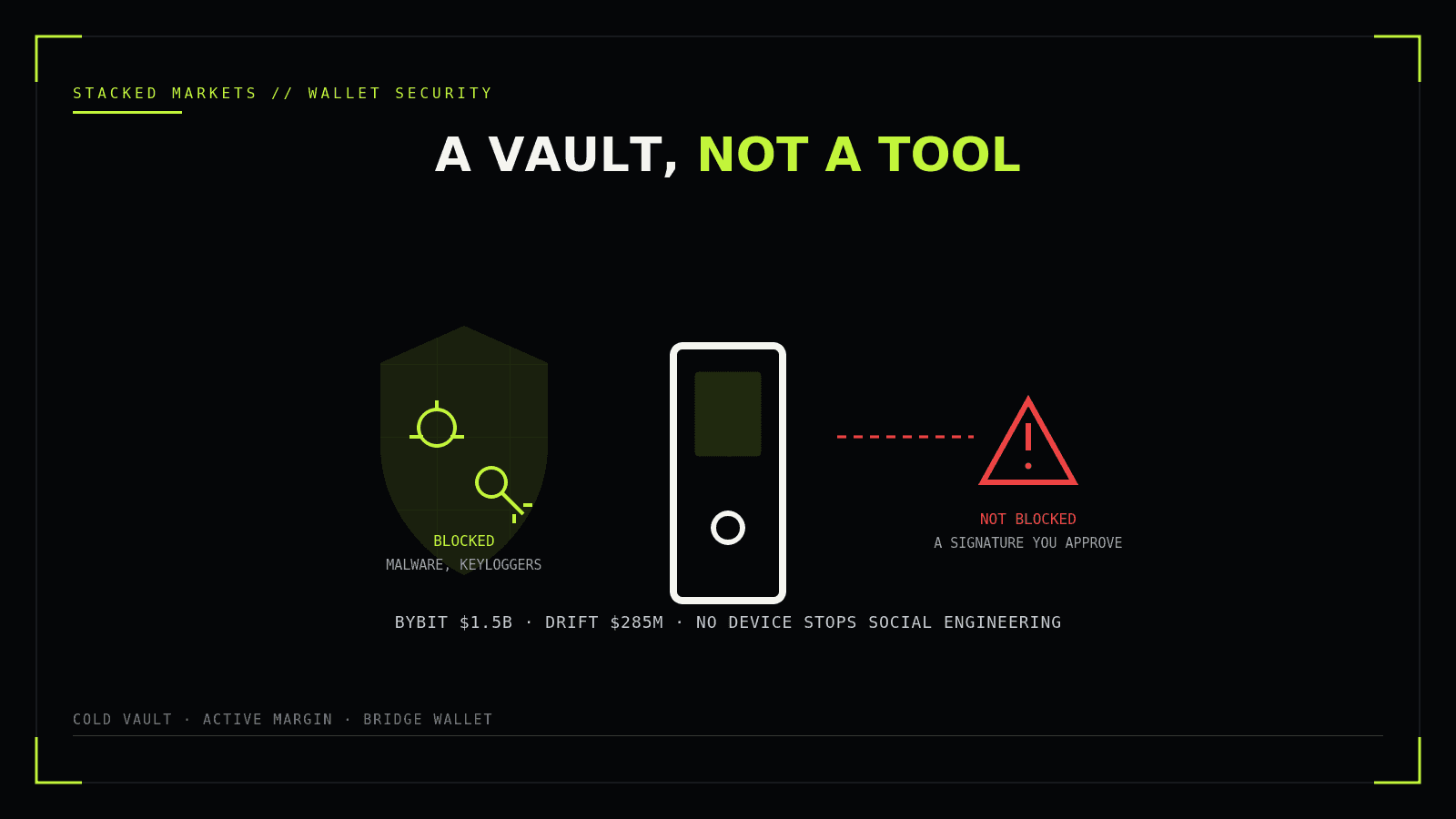
The device protects the key. It does not protect you from approving a malicious transaction. If you connect to a phishing site that mimics a legitimate protocol and click confirm on a transaction that drains your wallet, your hardware wallet will sign it. The device confirmed what you approved. You approved the wrong thing. Key isolation is irrelevant here.
Likewise, if someone steals your seed phrase - through physical theft, a camera, or social engineering - they can reconstruct your wallet on any device. The hardware is gone. The seed phrase is the wallet.
The Bybit hack in early 2025 resulted in approximately USD 1.5 billion in losses. The Drift Protocol incident involved approximately USD 285 million. Both originated from social engineering, not malware. A hardware wallet would not have prevented either. No device protects you from approving a bad transaction or losing your seed phrase.
The hardware wallet's job is narrow and specific: keep the private key off the host machine. That job is genuinely valuable. It's just not unlimited.
The active trader objection: "hardware wallets slow me down"
This objection is correct.
For active perp trading, hardware-signing every individual order is impractical. If you're trading on Hyperliquid and need to enter a position, adjust a stop, add margin, or flip direction quickly, waiting for a physical device confirmation on each action makes the workflow unusable. Latency matters. Physical button presses add seconds per action, and those seconds compound across a session.
The mistake isn't recognising the friction. The mistake is concluding that hardware wallets are therefore irrelevant for active traders. That's applying the wrong tool to the wrong job.
The three-bucket framework
Active on-chain traders should think in three buckets:
- Cold vault - long-term holdings, accumulated profits, funds not needed for trading. This wallet is hardware-backed. It transacts infrequently. When it does, you take the time to hardware-sign carefully.
- Active margin account - funds deposited into Hyperliquid for active trading. This is on-chain, not held by Stacked Markets or any other front-end. The margin lives on the protocol, actively cycling through positions.
- Bridge/approval wallet - the wallet you use for large bridging events, withdrawals back to cold storage, and setting or revoking token approvals. Hardware-backed for the large, infrequent transactions where the time cost of hardware signing is worth the security gain.
The hardware wallet belongs in buckets one and three. Not bucket two.
The agent wallet bridge
Stacked Markets has an optional agent wallet that addresses the speed problem directly without compromising the custody model.
The agent wallet uses a local browser-based signing key to speed up order approvals. You don't hardware-sign every order. The key is local to your browser - it never reaches Stacked Markets servers. Your margin stays on Hyperliquid, not with Stacked Markets. Stacked holds zero balances and zero signing keys regardless of whether you use the agent wallet.
This is the practical bridge for active traders: hardware wallet for the cold vault and for large bridging and withdrawal flows, agent wallet for active order signing within a session. Custody stays where it belongs throughout.
When hardware signing is actually essential for an active trader
Even if you never hardware-sign an individual trade, there are specific moments where the device earns its place:
- Large bridging events - moving significant USDC from Arbitrum into Hyperliquid margin. One deliberate transaction, high value. Take the time to hardware-sign it.
- Withdrawing accumulated profits to cold storage - moving funds back from Hyperliquid to your cold vault. Same logic.
- Setting and revoking token approvals - approval transactions are high-risk because a malicious approval can drain a wallet silently over time. Hardware signing gives you the device screen as a second check.
- Initial wallet setup and seed phrase generation - generating a seed phrase on a hardware device means it was never on a networked machine. This is the most important step.
Hardware wallet comparison for active DeFi traders in 2026
Ledger Stax
The usability benchmark as of 2026. Bluetooth connectivity, a large curved E Ink display, and the most mature clear signing support across DeFi protocols. Ledger's clear signing initiative has expanded coverage significantly, which matters for traders who want to read what they're approving on the device screen rather than trusting the browser UI. Priced at approximately USD 399.
The Bluetooth connection adds a wireless attack surface that USB-only devices don't have. Ledger's 2020 data breach - which exposed customer email and shipping addresses, not private keys or seed phrases - made Ledger owners targets for phishing and physical theft. Worth factoring in.
Trezor Safe 5
Open-source firmware is the headline. The full codebase is publicly auditable, which matters to traders who want to verify claims rather than trust them. No Bluetooth - USB and QR signing only. The QR signing option allows full air-gapping, with no direct data connection between the host machine and the device. Priced at approximately USD 169. For traders who prioritise verifiability over convenience, Trezor's open-source approach is the strongest argument.
BitBox02
Minimalist design, USB-C only, open-source firmware. The multi-edition supports multiple assets; the Bitcoin-only edition does exactly what it says. Priced at approximately USD 149. DeFi app coverage is thinner than Ledger's, but the security model is clean and the form factor is compact. A solid option for traders who want open-source without the Trezor price point.
Tangem
Card form factor, NFC-based signing, no seed phrase. The no-seed-phrase model is the defining trade-off: you get three cards, each containing the key, and recovery requires at least two of the three. There's no 24-word phrase to back up or lose. Priced at approximately USD 49 to USD 79 for a three-card set.
Lose two of three cards, and the funds are gone. For traders who want a simple hardware option for occasional large transactions, the low price and card form factor are practical. For anyone who wants the standard seed phrase backup model, look elsewhere.
The practical setup for an active on-chain trader
- Cold vault wallet - generated on a hardware device, seed phrase written on metal and stored offline, never imported into any browser. Holds long-term positions and accumulated profits. Transacts infrequently.
- Active trading wallet - a hot wallet connected to Hyperliquid. Funds here are limited to what you're actively deploying as margin. If this wallet is compromised, the damage is bounded.
- Stacked Markets agent wallet - optional, local browser-based key for session-level order signing. Speeds up active trading without exposing your cold vault or your Hyperliquid margin to unnecessary signing overhead.
Large bridging and withdrawal transactions go through the hardware device. The active trading session does not.
The honest verdict
Active perp traders need a hardware wallet. Not for signing every order - that's not what they're for. For the cold vault, for large bridging events, for withdrawing profits to long-term storage, and for setting or revoking approvals on high-value contracts.
The "hardware wallets are for HODLers" framing is wrong. It's a cold storage device that belongs in every serious on-chain trader's setup. The question is which transactions it signs, not whether it exists in your stack.
Coin Bureau's April 2026 ranking of the top hardware wallets placed usability and DeFi compatibility as the primary criteria for active traders - specifically the ability to clearly decode smart contract interactions on the device screen. The consistent finding: the security gap between hardware and software wallets is wide. The convenience gap for active trading is also wide. The answer isn't to pick one - it's to use both for different purposes.
If you're trading perpetual futures on Hyperliquid and want to see how non-custodial order flow works in practice, start on testnet first.
FAQs
Can I use a hardware wallet directly with Hyperliquid?
Yes. You can connect a hardware wallet to Hyperliquid's front-end or to Stacked Markets by selecting it during the wallet connection flow. Each transaction will require physical confirmation on the device. For active trading sessions with frequent order submissions, this creates significant friction - which is why most active traders use a hot wallet for the trading account and reserve the hardware wallet for large, infrequent transactions like bridging and withdrawals.
Does a hardware wallet protect me from phishing attacks?
Partially. It protects your private key from being extracted by malware on your host machine. It does not protect you from approving a malicious transaction on a phishing site. If you connect to a fake protocol and confirm a transaction that drains your wallet, the hardware wallet signs what you approved. The protection is against key extraction, not against approving the wrong thing.
What happens if my hardware wallet breaks or gets lost?
Your funds aren't stored on the device - they're on-chain. The device stores the private key that controls those funds. As long as your seed phrase is backed up securely, you can restore your wallet on a new device. If you lose both the device and the seed phrase, the funds are unrecoverable. Seed phrase backup is the most important step in hardware wallet setup.
Is Ledger's Bluetooth connection a security risk?
It adds a wireless attack surface that a USB-only device doesn't have. In practice, exploiting Bluetooth on a hardware wallet requires physical proximity and a sophisticated attack. The more relevant risk for most traders is the 2020 data breach that exposed customer shipping and email data - not private keys or seed phrases, but enough to make Ledger owners targets for physical theft or phishing. It's a known factor to weigh against the usability benefit of Bluetooth.
What is the Stacked Markets agent wallet and is it safe?
The agent wallet is an optional feature that uses a local browser-based signing key to speed up order approvals during active trading sessions. The key is generated and stored locally in your browser - it never reaches Stacked Markets servers. Your margin stays on Hyperliquid throughout. Stacked Markets holds zero balances and zero signing keys. The agent wallet trades some of the security of hardware signing for the speed required in active trading, which is a reasonable trade-off for the active margin account bucket specifically.
Should I use a hardware wallet for my entire crypto portfolio?
The cold vault portion - long-term holdings, accumulated profits, anything you're not actively trading - should be hardware-backed. Your active trading margin doesn't need hardware signing on every transaction, but the wallet holding your long-term holdings should. The three-bucket framework (cold vault, active margin, bridge/approval wallet) is a practical way to apply hardware security where it matters most without making active trading unworkable.
Does open-source firmware actually matter for hardware wallets?
Yes, if you care about verifying claims rather than trusting them. Open-source firmware means the codebase can be audited by anyone. Trezor and BitBox02 both use open-source firmware. Ledger's is closed-source. For traders who want to verify that the device does what it claims, open-source is the stronger option. For traders who prioritise DeFi app compatibility and usability, Ledger's ecosystem is more mature. Both are defensible depending on your priorities.