
Stacked Markets
How Hyperliquid's Order Book Works: CLOB Mechanics for Perp Traders
Published Jul 4, 2026 · By Stacked Markets Research Team
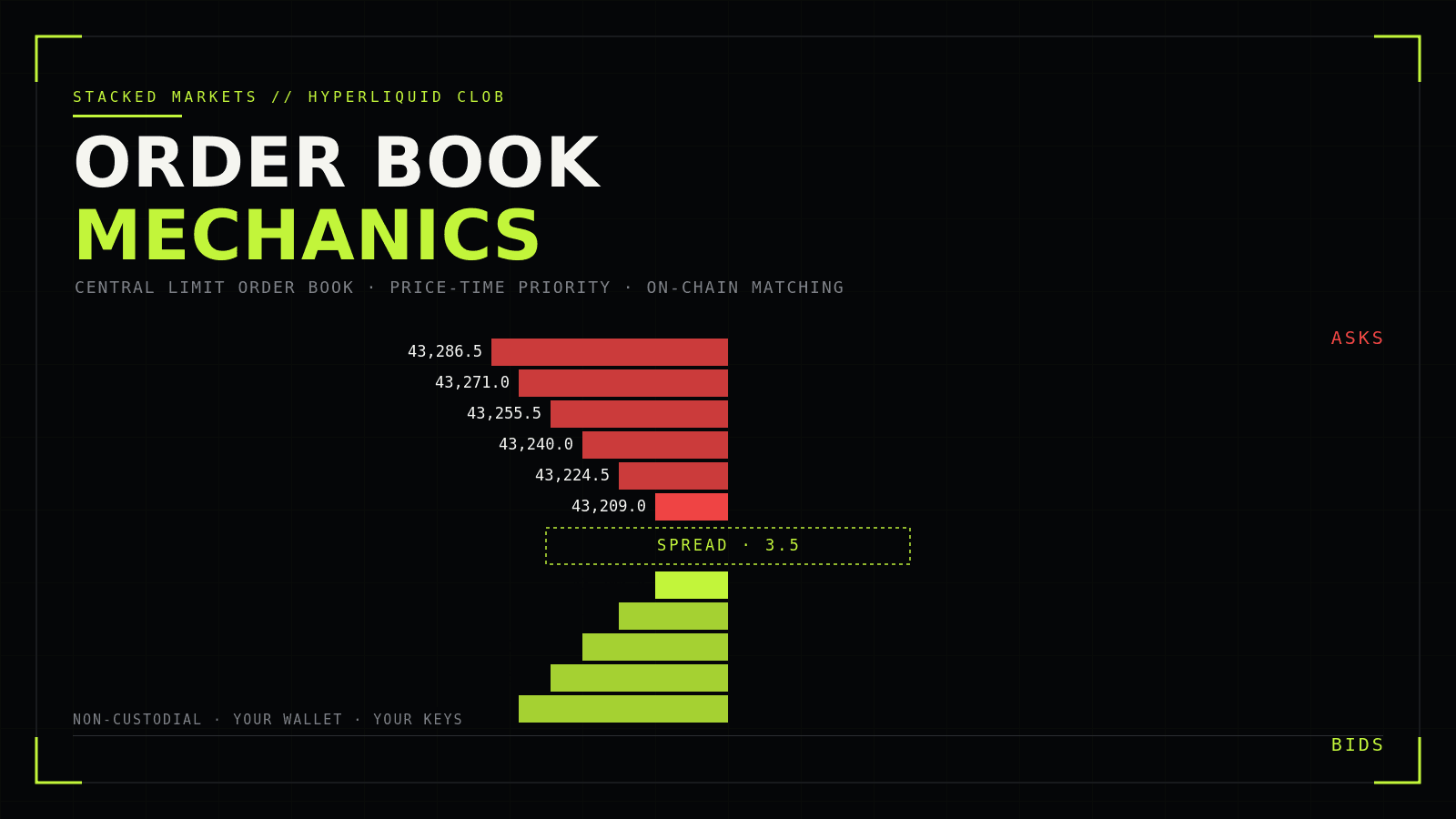
Most traders using Hyperliquid have a working sense of what a central limit order book is. You place a bid or ask, the engine matches it, you get filled. That mental model is correct as far as it goes. What it misses is how Hyperliquid's CLOB differs from both traditional exchange order books and earlier on-chain attempts to replicate them — and why those differences matter when you're sizing positions and managing execution risk.
This article covers the mechanics of Hyperliquid's order book, how orders move through it, what order types actually exist on-chain, and what the architecture means for your fills, your latency, and your counterparty exposure. It does not cover Hyperliquid tokenomics, vault mechanics, or governance.
What a CLOB is and how it differs from an AMM
A CLOB matches buyers and sellers by price and time. Resting orders sit in a queue at specific price levels. When an incoming order crosses the spread, the engine matches it against the best available resting order. Price-time priority determines who gets filled first: best price wins, and among equal prices, earlier orders win.
An AMM (automated market maker) works differently. It prices trades using a formula applied to a liquidity pool — you trade against the pool, not against another participant's resting order. Slippage is a function of pool depth and trade size, not of where other traders placed their limits.
The distinction matters for perp traders. On an AMM, you cannot place a limit order at a specific price and wait for it to fill. On a CLOB, you can. You also get a visible order book showing real resting liquidity at each price level — the foundation for reading depth and estimating execution impact before you trade.
Hyperliquid uses a CLOB. That is its core architectural choice.
How Hyperliquid runs a CLOB on-chain
Running a CLOB on a general-purpose blockchain like Ethereum is impractical for active trading. Block times of 12 seconds and gas costs per transaction make order placement and cancellation prohibitively slow and expensive. Earlier on-chain perp protocols worked around this by moving the order book off-chain and only settling final positions on-chain — which reduces counterparty risk but reintroduces a trusted intermediary for matching.
Hyperliquid takes a different approach. It runs on a purpose-built Layer 1 blockchain with a consensus mechanism optimised for order book throughput. The chain processes order placement, modification, and cancellation at sub-second latency. Matching happens on-chain, not on a centralised server. Settlement is verifiable. You can inspect positions, funding accruals, and liquidation levels directly from the chain state.
This is the meaningful architectural difference from custodial exchanges and hybrid on-chain/off-chain perp protocols. The matching engine is not a black box operated by a company — it runs on a validator set and produces verifiable output.
The trade-off is that Hyperliquid's L1 is not Ethereum. It is a separate chain with its own validator set and security assumptions. You are not inheriting Ethereum's security when you trade on Hyperliquid. That is worth understanding clearly before you commit significant collateral.
Order types available and what "no true market orders" means
Hyperliquid's CLOB supports limit orders, IOC (immediate-or-cancel) orders, and post-only orders. There is no native market order in the traditional sense.
A market order on a custodial exchange instructs the engine to fill your trade at whatever price is available. On Hyperliquid, the equivalent is an IOC limit order placed at a price that crosses the spread. You specify a price limit; the engine fills as much as it can at that price or better and cancels the remainder immediately. If the market moves before your order reaches the matching engine, you do not get filled at a worse price than your limit — you get a partial fill or no fill.
This is not a limitation. It is a protection. A true market order on a thin book can fill far from the mid. An IOC limit with a defined slippage bound gives you a worst-case fill price before you submit.
When you trade through Stacked Markets at stackedmarkets.com, the interface surfaces this directly. You see the worst-case fill price before your wallet prompts you to sign. The IOC structure is visible, not hidden behind a "market order" label that obscures what you're actually submitting.
Post-only orders are the opposite of IOC. They rest on the book as maker orders and are cancelled if they would immediately cross the spread. Use them when you want to earn maker rebates and are willing to wait for a fill.
How matching works and what determines fill priority
Hyperliquid's matching engine applies price-time priority. At any given price level, the order that arrived first gets filled first. When a new aggressive order enters the book, the engine walks through resting orders from best price to worst, filling in sequence until the incoming order is exhausted or no more resting orders cross the spread.
Partial fills are common in active markets. Place a large limit order at the best ask with insufficient resting bid volume to fill it completely, and the matched portion settles immediately while the remainder rests on the book.
The on-chain nature of the matching engine means the fill sequence is deterministic and auditable. There is no exchange-side discretion in how orders are matched. The validator network executes the matching logic, and the output is recorded on-chain.
One practical implication: order cancellation competes with order placement for block inclusion. In fast-moving markets, a cancel request submitted milliseconds after a fill request may not prevent the fill. This is a property of any on-chain system where transactions are ordered by the network rather than by a centralised server with privileged cancel logic.
Funding rates and their relationship to order book state
Perpetual futures do not expire. The mechanism that keeps the perp price anchored to spot is the funding rate. When the perp trades above spot, long positions pay short positions. When it trades below spot, short positions pay long positions. Funding accrues on open positions at regular intervals.
The funding rate is a function of the premium — the difference between the perp's mark price and the index price. The mark price derives from the order book's mid. When aggressive buying pushes the mid above the index, the premium rises, the funding rate rises, and longs pay more to hold their position. That creates a mechanical incentive for arbitrageurs to short the perp and buy spot, compressing the premium back toward zero.
This connection between order book state and funding is operationally important. A persistently elevated funding rate tells you the book is skewed long. Holding a long position in that environment has a carrying cost that compounds over time — a position that looks profitable on paper can erode through funding if you hold it long enough.
Funding on Hyperliquid settles hourly. You can verify accrued funding on-chain.
What the CLOB architecture means for your execution
The on-chain CLOB has concrete implications for how you approach execution.
- Visible depth is real depth. Resting orders on Hyperliquid's book represent actual signed on-chain commitments. They are not indicative quotes that can be pulled before your order reaches the engine — which makes the depth display more reliable than on many hybrid systems.
- Latency is not zero. On-chain consensus introduces latency that a centralised matching engine does not have. For most position traders, this is irrelevant. For strategies that depend on sub-millisecond execution, it is a binding constraint.
- Cancellations are not instant. Cancel transactions compete for block inclusion. In volatile conditions, you may not be able to cancel a resting order before it fills.
- Liquidations are on-chain. If your margin falls below the maintenance threshold, the liquidation engine acts on-chain. You can verify your liquidation price from the chain state. There is no exchange discretion in when liquidation is triggered.
The honest trade-off
The CLOB on a purpose-built L1 solves real problems. Matching is verifiable. Custody is non-custodial. Depth is real. IOC limits protect you from uncapped slippage. These are genuine improvements over custodial exchange structures where counterparty risk comes with every deposit.
The costs are real too. Hyperliquid's L1 is not a battle-tested, maximally decentralised network. The validator set is smaller than Ethereum's, and the chain is purpose-built — which means it has not faced the full range of adversarial conditions that older networks have. A validator set failure or network partition would affect your ability to cancel orders or withdraw collateral during the event.
The on-chain matching model also means you cannot replicate execution strategies that depend on centralised engine privileges — direct market-maker API access with sub-millisecond cancel rights, for example. If your strategy requires that, Hyperliquid is not the right venue.
For most position traders and active directional traders, the trade-off is favourable. You get professional-grade order book mechanics, verifiable settlement, and no custodial risk. You accept some latency and a newer chain's security profile.
Five questions worth asking
- Do you understand the difference between your IOC limit price and the current best ask, and have you set a slippage bound that reflects actual book depth rather than a default?
- Have you checked the current funding rate before entering a leveraged position, and do you know how long you plan to hold it?
- Do you know your liquidation price on-chain, and have you verified it matches what the interface shows?
- Are you using post-only orders in low-volatility conditions where maker rebates would meaningfully reduce your cost basis?
- Have you considered how a Hyperliquid L1 network event would affect your ability to manage open positions, and do you have a contingency for that scenario?
FAQs
Does Hyperliquid use an AMM or a CLOB?
Hyperliquid uses a central limit order book (CLOB). Orders are matched by price-time priority against resting limit orders. There is no automated market maker formula involved in price discovery or execution.
Why doesn't Hyperliquid have true market orders?
The protocol does not support native market orders. The equivalent is an IOC (immediate-or-cancel) limit order placed at a price that crosses the spread. You define a worst-case fill price before submitting. If the market moves past your limit, you get a partial fill or no fill rather than an uncapped slip.
How does Hyperliquid run an order book on-chain without prohibitive latency?
Hyperliquid operates a purpose-built Layer 1 blockchain with consensus optimised for order book throughput. This allows sub-second order placement and cancellation, unlike general-purpose chains where each transaction requires block inclusion at 12-second intervals.
What determines fill priority on Hyperliquid's order book?
Price-time priority. At a given price level, the order that arrived first fills first. When an aggressive order enters the book, the engine fills resting orders from best price to worst until the incoming order is exhausted or no more resting orders cross the spread.
How does the funding rate connect to order book state?
The funding rate derives from the premium between the perp's mark price and the index price. The mark price tracks the order book's mid. When aggressive buying pushes the mid above the index, the premium rises and longs pay shorts. That creates an arbitrage incentive that pulls the perp price back toward spot.
Can I cancel an order instantly on Hyperliquid?
No. Cancel transactions require on-chain inclusion and compete with other transactions for block space. In fast-moving markets, a cancel submitted after a fill request may not prevent the fill. This is a structural property of on-chain matching, not a bug.
Is the order book depth shown in the interface reliable?
More so than on many hybrid systems. Resting orders on Hyperliquid represent signed on-chain commitments — they cannot be pulled by a market maker before your order reaches the engine in the way that indicative quotes can be withdrawn on some off-chain systems. That said, orders can still be cancelled before your transaction is included in a block.