
Stacked Markets
Pre-IPO perpetual futures on Hyperliquid: how they work, how prices are derived, and what the risks actually are
Published Jul 4, 2026 · By Stacked Markets Research Team
Hyperliquid already had a reputation for moving fast. Then SpaceX listed on Nasdaq on June 12, 2026 — the largest IPO in history, raising USD 75 billion, 4x oversubscribed — and the pre-IPO perpetual futures market that had been running since May 18 became a case study in what this category of instrument can and cannot do.
This article covers the mechanics behind pre-IPO perps, how prices are actually derived (it's not what most traders assume), what went wrong with the oracle during the SpaceX stock split, and what the pipeline of upcoming AI IPOs means for anyone considering trading these instruments.
If you already know what a perpetual future is, you're in the right place. This isn't a primer on perps. It's a specific look at a specific category with specific failure modes.
What a pre-IPO perp actually is
A pre-IPO perpetual future is a cash-settled synthetic derivative that tracks a reference price for a private company's equity before that company goes public. You are not buying shares. You have no ownership stake. You have no claim on the company at IPO.
That distinction matters more than it sounds. When SpaceX listed at a valuation implying roughly USD 135 per share, traders holding the SPCX perp on Hyperliquid were not automatically entitled to shares at that price. They held a position in a synthetic instrument whose value was determined by the mark price of the perp itself — and by whatever oracle mechanism the deployer had configured to reference it.
These are not equity instruments wearing a perpetual futures costume. They are purely speculative price-discovery vehicles. The underlying company only needs to exist at settlement or conversion. During the perp's lifetime, the price is whatever the market and the oracle agree on.
How HIP-3 works and who deploys these markets
Hyperliquid's HIP-3 framework lets third-party teams deploy their own perpetual markets on Hyperliquid's infrastructure. The deployer sets the parameters: the ticker, the oracle configuration, the initial reference price, and the settlement mechanics. Hyperliquid provides the on-chain order book and matching engine.
HIP-3 markets have processed over USD 120 billion in total volume since launch. On April 8, 2026, HIP-3 deployers generated 48.1% of Hyperliquid's total platform volume in a single day. That's not a niche experiment — it's a significant share of one of the most liquid on-chain derivatives venues in existence, a platform that has done USD 3 trillion in annual volume.
The team behind the OpenAI and Anthropic perps was Ventuals. They ran those markets, then shut down on June 15, 2026 — three days after the SpaceX IPO — settled all open positions, and moved to another project within the ecosystem. That's third-party deployer risk in practice: the market exists as long as the deployer chooses to run it.
How prices are derived — the oracle problem
This is where most traders have an incomplete mental model.
Traditional perpetual futures on centralised exchanges use an external spot oracle — typically a weighted average of prices across multiple spot markets — to anchor the mark price and calculate funding. The perp price is continuously pulled toward a real-world reference.
Hyperps, Hyperliquid's native perp format used by HIP-3 deployers, work differently. The funding rate is determined relative to a moving average of the hyperp mark price itself. There is no external spot oracle continuously pulling the price toward a real-world reference during the contract's lifetime. Price is anchored by what traders in the market are willing to pay, not by a live external feed.
Two consequences follow. The price is more stable in the sense that it's less susceptible to oracle manipulation attacks from external spot markets. But the market can also drift significantly from any rational estimate of fair value if sentiment runs hard in one direction. The crowd is the oracle.
When the oracle fails anyway
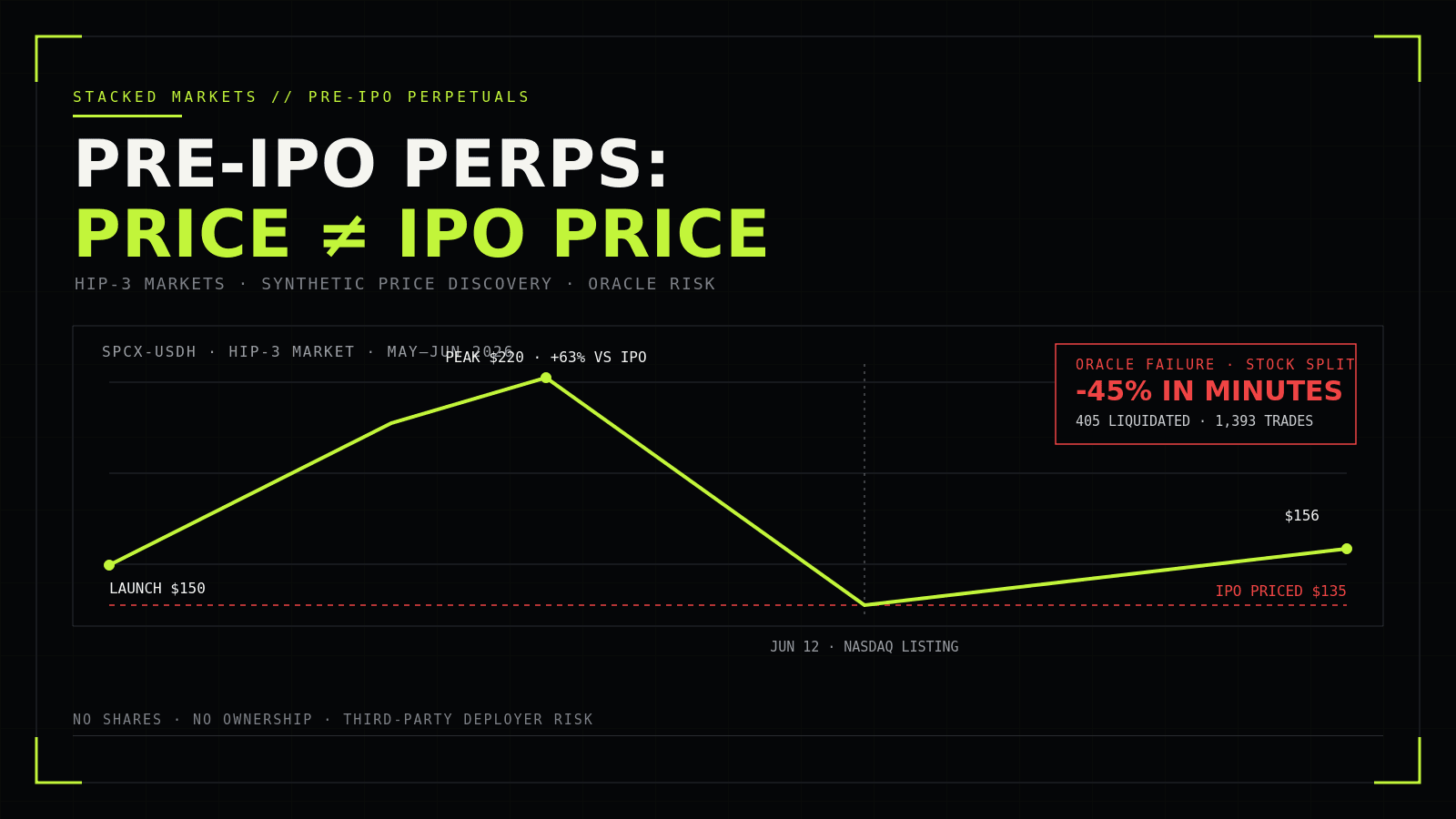
The SPACEX-USDH market on Ventuals demonstrated what happens when an external reference is introduced at the wrong moment. When SpaceX executed a 5-for-1 stock split, Notice.co's oracle — which Ventuals had integrated for that specific event — mishandled the adjustment. The mark price crashed 45%, from USD 2,277 to USD 1,254. 405 users were liquidated. 1,393 trades executed during the cascade.
That's not a theoretical risk. It happened on a high-profile instrument with significant open interest, triggered by a single point of failure in the price feed at a moment of corporate action.
The SpaceX trade: what happened from May to June 2026
SPCX launched on Hyperliquid on May 18, 2026, with an opening reference price of USD 150 — implying a valuation of approximately USD 1.78 trillion. The market moved fast. Price traded up to USD 203 quickly, then peaked above USD 220.
SpaceX priced its IPO at USD 135 per share and listed on Nasdaq on June 12, 2026, at a valuation of USD 1.75 to 1.77 trillion. By June 23, 2026, SPCX was trading around USD 156 on Hyperliquid.
Around the IPO date, SpaceX-linked assets on Hyperliquid did USD 1.3 billion in single-day volume — the second most traded asset on the platform that day.
The 24/7 nature of the perp market is a genuine differentiator here. When Nasdaq was closed, the Hyperliquid market was open. Traders could respond to SpaceX news, Starship launch outcomes, or macro shifts at 3am on a Sunday. Traditional equity markets can't offer that.
What the perp market could not offer was any certainty about where the IPO would price. The pre-IPO price peaked above USD 220 before the IPO priced at USD 135. The market overshot by a wide margin, then corrected sharply.
What the Cerebras precedent tells you about price discovery
Cerebras Systems ran the same playbook before SpaceX. The pre-IPO perp was pricing the stock at approximately USD 175 at the time of the IPO. The stock opened at USD 350. The pre-IPO perp was roughly 80% wrong on price.
That's not a failure of the instrument. It's a feature of what the instrument actually is: a market of on-chain traders speculating on a private company's valuation with incomplete information. The crowd can be directionally right — the company is worth something, it's going up — and quantitatively wrong on the actual IPO price at the same time.
Pre-IPO perps are not reliable price discovery mechanisms for IPO pricing. They reflect sentiment, not fundamental analysis. If you're trading them, you're making a bet on market sentiment — not a bet on the company's actual valuation at listing.
The AI IPO pipeline: Anthropic, OpenAI, Databricks
The next wave of high-profile pre-IPO perps will likely be AI companies. Anthropic raised USD 30 billion in a Series G at a USD 380 billion valuation in February 2026. Polymarket currently prices the probability of an Anthropic IPO by December 31, 2026 at 72%. Databricks has hinted at an IPO. OpenAI submitted a confidential S-1 to the SEC.
These are the names traders are watching. When Ventuals shut down, the Anthropic and OpenAI perps they ran went with them. New deployers could launch replacements — the HIP-3 framework makes that straightforward from a technical standpoint.
The S&P 500 perp launched on Hyperliquid in March 2026 via Trade.xyz — with an official S&P Dow Jones Indices licence — shows how far the category has extended. Pre-IPO equity perps are one part of a broader expansion of what on-chain derivatives can reference.
The honest trade-off
Pre-IPO perps on Hyperliquid give you something traditional markets don't: 24/7 speculative exposure to private companies before they list. That's a real benefit. The SpaceX market did USD 1.3 billion in a single day because traders wanted that exposure and had no other liquid venue to get it.
The costs are equally real.
You hold no shares and no ownership. If the company lists and the perp oracle fails, you can be liquidated at a price that has nothing to do with the actual IPO. The Cerebras perp was 80% wrong on price. The SpaceX perp peaked 63% above the IPO price before correcting.
Third-party deployers can shut down with short notice. Ventuals did. The market disappears when the deployer decides to move on.
Liquidity can be thin outside of high-interest periods. A 24/7 market is only useful if there's a counterparty on the other side.
These instruments are genuinely useful for expressing a view on a high-profile private company. They are not a substitute for equity research, and they are not a reliable signal for where the IPO will price.
Five questions worth asking before you trade
- Who deployed this market, and what is their track record of maintaining it through corporate actions like stock splits or secondary offerings?
- What oracle mechanism does this perp use, and what happens to your position if the oracle fails or is updated incorrectly?
- How liquid is the order book outside of peak trading hours? A USD 1.3 billion volume day is not the baseline — it's the exception.
- What is your position size relative to open interest? In thin markets, your exit can move the price against you.
- Are you expressing a view on the company's long-term value, or on short-term sentiment? Those are different trades with different risk profiles.
FAQs
What is a pre-IPO perpetual future?
A pre-IPO perpetual future is a cash-settled synthetic derivative that lets you speculate on a private company's share price before it lists on a public exchange. You receive no shares and hold no ownership stake. The instrument settles in cash based on a reference price determined by the market and the deployer's oracle configuration.
How is the price of a Hyperliquid pre-IPO perp determined?
Hyperps use a funding rate anchored to a moving average of the mark price itself, rather than a continuously updated external spot oracle. Price reflects on-chain market sentiment. An external oracle may be introduced for specific events like stock splits, which introduces its own failure risk — as the SPACEX-USDH incident in 2026 demonstrated.
What is HIP-3 on Hyperliquid?
HIP-3 is Hyperliquid's framework that allows third-party teams to deploy their own perpetual futures markets on Hyperliquid's infrastructure. Deployers set the parameters, including the oracle, ticker, and settlement mechanics. HIP-3 markets have processed over USD 120 billion in total volume since launch.
Are pre-IPO perps accurate at predicting IPO prices?
No. The Cerebras pre-IPO perp priced the stock at approximately USD 175 at IPO. The stock opened at USD 350. The SpaceX perp peaked above USD 220 before the IPO priced at USD 135. Pre-IPO perps reflect speculative sentiment, not fundamental valuation. They can be directionally interesting and quantitatively unreliable at the same time.
What happened with the SpaceX oracle failure?
When SpaceX executed a 5-for-1 stock split, Notice.co's oracle — integrated by Ventuals for the SPACEX-USDH market — mishandled the price adjustment. The mark price dropped 45%, from USD 2,277 to USD 1,254. 405 users were liquidated across 1,393 trades. A single point of failure in the price feed, at a moment of corporate action.
What AI company IPOs might generate pre-IPO perps in 2026?
Anthropic, OpenAI, and Databricks are the most-watched names. Anthropic raised at a USD 380 billion valuation in February 2026. OpenAI submitted a confidential S-1 to the SEC. Polymarket prices the probability of an Anthropic IPO by December 31, 2026 at 72%. New HIP-3 deployers could launch perps for any of these companies once interest is sufficient.
Can I trade pre-IPO perps without depositing funds with a platform?
Yes, on Hyperliquid. Because Hyperliquid is an on-chain protocol, you connect your own Ethereum-compatible wallet and your collateral stays in your custody. Front-ends like Stacked Markets route your orders to Hyperliquid's on-chain order book without ever taking custody of your funds.