stacked markets

Stacked Markets

Seed phrase security: the non-custodial trader's most important habit

Published Jul 4, 2026 · By Stacked Markets Research Team

Seed phrase security: the non-custodial trader's most important habit cover image

Contents

  1. The false sense of security
  2. Why seed phrases are uniquely dangerous
  3. The five most common ways seed phrases are compromised in 2026
  4. The habit system: seven concrete practices
  5. The passphrase deep-dive
  6. Multisig as the advanced tier
  7. The non-custodial trading context
  8. What a good habit system looks like in practice
  9. FAQs

You understand custody mechanics. You know what a CLOB is, how funding rates work, and why you won't deposit on a centralised exchange. You've done the work. And yet the most common way experienced non-custodial traders lose everything has nothing to do with protocol exploits or smart contract bugs.

It's the seed phrase. More specifically, it's treating seed phrase security as a one-time setup task rather than an ongoing discipline.

This isn't an explanation of what a seed phrase is. You know. It's about the specific ways traders who understand non-custodial architecture still get this wrong - and what a real habit system looks like.

The false sense of security

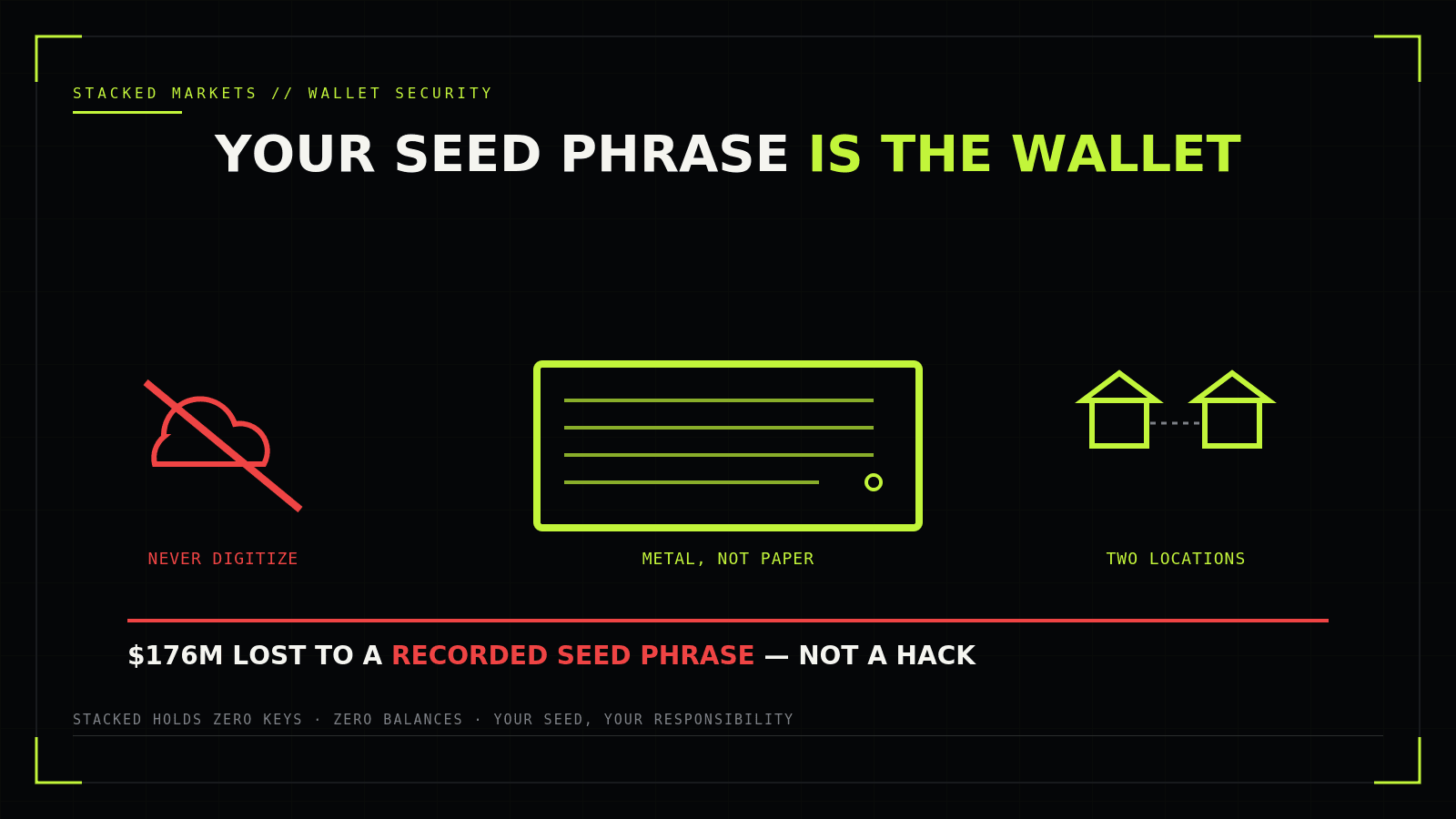
In March 2026, a UK High Court case made the mechanics of this failure unusually public. The case involved 2,323 BTC - approximately USD 176 million at the time. The funds weren't taken through a protocol exploit. They were accessed after a seed phrase was secretly recorded. No hack. No vulnerability. A human failure in physical security, documented in court filings.

The trader understood non-custodial wallets. The architecture worked exactly as designed. The seed phrase was the last line of defence, and it failed.

That tension is worth sitting with. The same architecture that protects you from exchange insolvency and withdrawal freezes provides zero protection against seed phrase compromise. Non-custodial means you hold the keys. It also means no one can help you if those keys are taken.

Why seed phrases are uniquely dangerous

Most security failures have a recovery path. A compromised email account can be recovered via phone number. A stolen password can be reset. A fraudulent bank transfer can sometimes be reversed.

A compromised seed phrase has none of that. No support ticket. No on-chain proof of ownership that overrides possession of the phrase. The 12 or 24 words are not a key to the wallet - they are the wallet. Whoever holds them controls it.

This isn't a design flaw. It's the architecture. But it means the consequences of failure are total and permanent. That asymmetry demands a different level of discipline than any other credential you manage.

The five most common ways seed phrases are compromised in 2026

Cloud sync: the most common, often accidental

Taking a photo of your seed phrase during setup - and having it automatically sync to iCloud or Google Photos - is the single most widespread failure mode. It happens in seconds, often without the trader realising the sync is active. Once that image exists in a cloud account, it's accessible to anyone who compromises that account. Cloud credentials are among the most frequently phished.

The fix is absolute: never photograph your seed phrase. Not for temporary storage. Not "just this once." Not in a folder you think is private.

Physical theft and discovery

The UK High Court case illustrates this directly. Physical access to your backup - by a family member, an estranged partner, house staff, or anyone with access to your space - is a genuine threat vector. Most traders build a technical threat model and ignore the social one entirely.

Your seed phrase backup is a physical object. Treat it like one.

Fake hardware wallet mail

In February 2026, a sophisticated physical mail campaign targeted hardware wallet owners. Letters arrived with holographic seals, impersonated a hardware wallet CEO, and included QR codes directing recipients to enter their seed phrases. The campaign drew on the Ledger data breach of 2020, which exposed 272,000 customer records including names and physical addresses. That data is still circulating. The physical mail format specifically bypasses the email phishing awareness most traders have developed.

The principle is simple: legitimate hardware wallet manufacturers will never ask for your seed phrase. Not by mail, not by email, not through any channel.

AI-assisted phishing in 2026

Deepfake voice calls impersonating exchange support staff, AI-generated emails replicating known contacts with high fidelity, and automated phishing flows that adapt in real time are all documented in 2026. Approximately USD 17 billion was lost to crypto scams and fraud in 2025 according to Chainalysis research. TRM Labs' 2026 Crypto Crime Report recorded USD 158 billion in total illicit crypto flows in 2025 - a record. These operations are no longer random. They are systematic and increasingly personalised.

The defence hasn't changed: your seed phrase is never the answer to any question anyone asks you.

Industrialised drainers and compromised backups

A security audit analysing over 200,000 compromised wallets found that traditional paper-and-pen seed phrase backups are increasingly vulnerable to industrialised AI-driven drainer operations. The specific finding: paper backups that were photographed, scanned, or stored digitally at any point in their history represent a persistent risk - even if the trader believes they deleted the digital copy. Deletion is not the same as erasure.

The habit system: seven concrete practices

1. Never digitise your seed phrase

No photo. No note app. No cloud storage. No password manager. No email draft. No messaging app - not even to yourself. This rule has no exceptions. The moment a seed phrase exists in digital form, it is exposed to every attack vector that targets digital systems.

2. Metal backup over paper

Paper burns, floods, and degrades. Metal plates - products like CryptoTag, Cryptosteel, or Bilodeau plates - survive fire, water, and corrosion. For a backup that needs to last decades and withstand physical disasters, paper is the wrong material. The cost of a metal backup is trivial relative to the value it protects.

3. Two physical locations minimum

One backup at home isn't sufficient. A house fire, flood, or break-in eliminates it. Two backups in geographically separate locations - one at home, one at a trusted secondary location - means a single physical event cannot destroy your recovery path. This is basic redundancy, not paranoia.

4. BIP-39 passphrase hardening

The BIP-39 passphrase, sometimes called the "25th word," adds a second factor that is not stored on the device and not derivable from the seed phrase alone. Even if someone finds your 24 words, they cannot access the wallet without the passphrase. It creates an entirely new derivation path - a different wallet, not just a different password.

The inheritance risk is real and often overlooked: if you use a passphrase and don't document it separately, your estate cannot recover the funds. The passphrase must be stored separately from the seed phrase and included in any estate planning arrangement.

5. One seed per wallet type

Your trading wallet, cold vault, and any hot wallet should each have their own seed phrase. Never reuse seeds across wallets. If one seed is compromised, the damage is contained. Reusing seeds means a single failure cascades across every wallet you hold.

6. Recovery drill

Actually test your recovery. Every 6 to 12 months, use a different hardware device to restore from your seed phrase backup before loading any value onto the test device. Ledger's official guidance recommends running a recovery check immediately after initial setup. The point is to confirm the backup works - not to assume it does. A backup you've never tested is a backup you can't trust.

7. Social and family threat model

Who knows you hold crypto? Who has physical access to your home or office? Who might find your backup while looking for something else? These are OPSEC questions, not technical ones. Your threat model isn't complete until you've answered them honestly. The UK High Court case was not a technical failure. It was a social one.

The passphrase deep-dive

The BIP-39 passphrase extension works by appending an additional string to your seed phrase before the key derivation function runs. It is not stored on the hardware device. It is not part of the 12 or 24 words. The device has no knowledge of whether you're entering the correct passphrase - it will derive a valid but empty wallet from any passphrase, including a wrong one. This creates plausible deniability: a small decoy wallet on the seed phrase alone, and your real holdings behind the passphrase.

The use cases are clear: plausible deniability under physical coercion, an inheritance lock that requires both the seed and the passphrase, and a second factor against physical theft of the seed backup.

The risk is equally clear: passphrase loss is total loss. There is no recovery. The passphrase must be documented separately, stored securely, and included in any inheritance or estate arrangement. If you use a passphrase and die without documenting it, those funds are gone.

Multisig as the advanced tier

For high-value holdings, a 2-of-3 multisig setup or Shamir's Secret Sharing (SLIP-39) distributes the recovery burden across multiple keys or shares. Casa and Unchained Capital both offer institutional-grade multisig coordination for Bitcoin holders. The trade-off is honest: recovery is significantly more complex, and the operational overhead is real.

For most traders, a well-executed single-seed setup with a BIP-39 passphrase and metal backups in two locations is sufficient. Multisig makes sense when the value held justifies the added complexity and when you have the technical confidence to manage the recovery correctly.

Multisig is often recommended but infrequently implemented correctly - the complexity of recovery setups is the primary failure point. The recommendation to use multisig is only useful if you can actually execute the recovery.

The non-custodial trading context

When you trade perpetual futures through Stacked Markets, you sign each order with your wallet. Stacked holds no keys and no balances. That architecture protects you from exchange insolvency, withdrawal freezes, and custodial failure. It does not protect you from seed phrase compromise.

If your seed phrase is taken, everything in that wallet is gone. Your Hyperliquid margin, your open positions, your entire balance - accessible to whoever holds the phrase. Non-custodial architecture shifts the trust assumption from the exchange to you. That's the right trade-off. But it means seed phrase discipline isn't optional. It's the foundation the entire model rests on.

Hyperliquid's on-chain CLOB handles matching, margin, and settlement transparently. Every order is verifiable on-chain. None of that matters if the wallet signing those orders is compromised at the seed level.

What a good habit system looks like in practice

Security is not a setup task. It is a recurring practice.

Monthly: confirm your primary backup location is physically intact and accessible. Verify no seed phrase has been digitised at any point since the last check. Confirm your passphrase is documented separately and that documentation is accessible.

Quarterly: confirm your secondary backup location is intact. Confirm your recovery device is accessible and functional. Run a recovery check on a test device if it has been more than six months since the last one.

After any life change - new living situation, new relationship, new household staff, new business partner - update your threat model. Who now has physical access to your space? Who now knows you hold crypto? Adjust backup locations and access controls accordingly.

The threat model is not static. Your life changes. Your security posture needs to change with it.


Learn more about non-custodial trading at Stacked Markets.

stackedmarkets.com

FAQs

Should I use a password manager to store my seed phrase?

No. Absolute answer. Password managers are digital systems exposed to phishing, credential theft, software vulnerabilities, and company-level breaches. Your seed phrase must never exist in any digital form. A password manager is not an exception to this rule.

What happens if I lose my BIP-39 passphrase?

Total loss. There is no recovery path. The passphrase is not stored on the device, not derivable from the seed phrase, and not recoverable by any third party. If you use a passphrase, document it separately from your seed phrase and include it in your estate planning. This is not optional.

Is splitting my seed phrase in half a safe backup strategy?

No. Splitting a BIP-39 seed phrase in half does not create two independent shares - it creates two fragments that are individually useless but together expose the full phrase to anyone who finds both. This is not the same as Shamir's Secret Sharing (SLIP-39), which is a cryptographically sound threshold scheme. Half-splitting is not a security measure.

Can I store my seed phrase on a metal plate in a bank safety deposit box?

Yes, and it's a reasonable secondary location. The considerations: the bank has physical access to the box under certain legal circumstances, and access may be restricted or delayed after your death. If you use a safety deposit box as one of your two locations, factor inheritance access into your estate planning. It's a valid option, not a perfect one.

What happens to my seed phrase and wallet when I die?

Without explicit planning, your wallet is inaccessible to your estate. Your heirs need the seed phrase and, if you use one, the BIP-39 passphrase. Both should be documented separately, stored securely, and referenced in your will or estate instructions. A solicitor or estate attorney familiar with digital assets can structure this correctly. This is a legal and logistical problem, not a technical one.

Does Stacked Markets have my seed phrase or signing keys?

No. Stacked Markets holds zero keys and zero balances. When you use the optional agent wallet feature, the signing key is generated locally in your browser and never transmitted to Stacked Markets servers. Your seed phrase is never involved in the Stacked Markets interface at any point. The non-custodial architecture is structural, not a setting.

Is a 12-word seed phrase less secure than a 24-word phrase?

A 12-word phrase provides 128 bits of entropy. A 24-word phrase provides 256 bits. Both are computationally unbrute-forceable with current and near-future hardware - the attack surface is not the entropy of the phrase but the physical and operational security around it. If you're generating a new wallet, use 24 words. If you already have a 12-word wallet secured correctly, the entropy is not your primary concern.

All trading involves risk.

Perpetual futures use leverage. You can lose all collateral. Stackedmarkets does not custody funds or hold your main wallet keys. We do not provide investment advice. Nothing here is an offer to buy or sell. Trade only with capital you can afford to lose. Always verify testnet vs mainnet in the product chrome.

Stacked Markets is a decentralized perpetual futures trading platform. All trading activities are conducted on-chain and are subject to blockchain network conditions and smart contract risks.

Trading perpetual futures involves substantial risk of loss and is not suitable for all investors. Past performance is not indicative of future results. The high degree of leverage can work against you as well as for you. Before deciding to trade, you should carefully consider your investment objectives, level of experience, and risk appetite.

The information provided on this platform does not constitute investment advice, financial advice, trading advice, or any other sort of advice, and you should not treat any of the platform's content as such.

stacked markets

© 2026 Stacked Markets. All rights reserved.

Seed phrase security: the non-custodial trader's guide