
Stacked Markets
Stacked Markets vs Bybit: what custody risk actually costs you
Published Jul 4, 2026 · By Stacked Markets Research Team
Contents
- What happened on May 28, 2026
- What Bybit's custody model actually means for you
- The cost that doesn't show up in the fee comparison
- What non-custodial trading changes - and what it doesn't
- The honest trade-off
- Five questions to answer before your next trade
- FAQs
What happened on May 28, 2026
On May 28, 2026, Bybit froze withdrawals for a portion of its user base. The details are still being worked out across public channels, but the pattern is familiar: a centralised exchange under stress, users locked out of their own funds, a support queue moving slower than the market.
This isn't a Bybit-specific failure. It's a structural one. When an exchange holds your collateral, you are an unsecured creditor until proven otherwise.
That distinction matters more than most traders realise.
What Bybit's custody model actually means for you
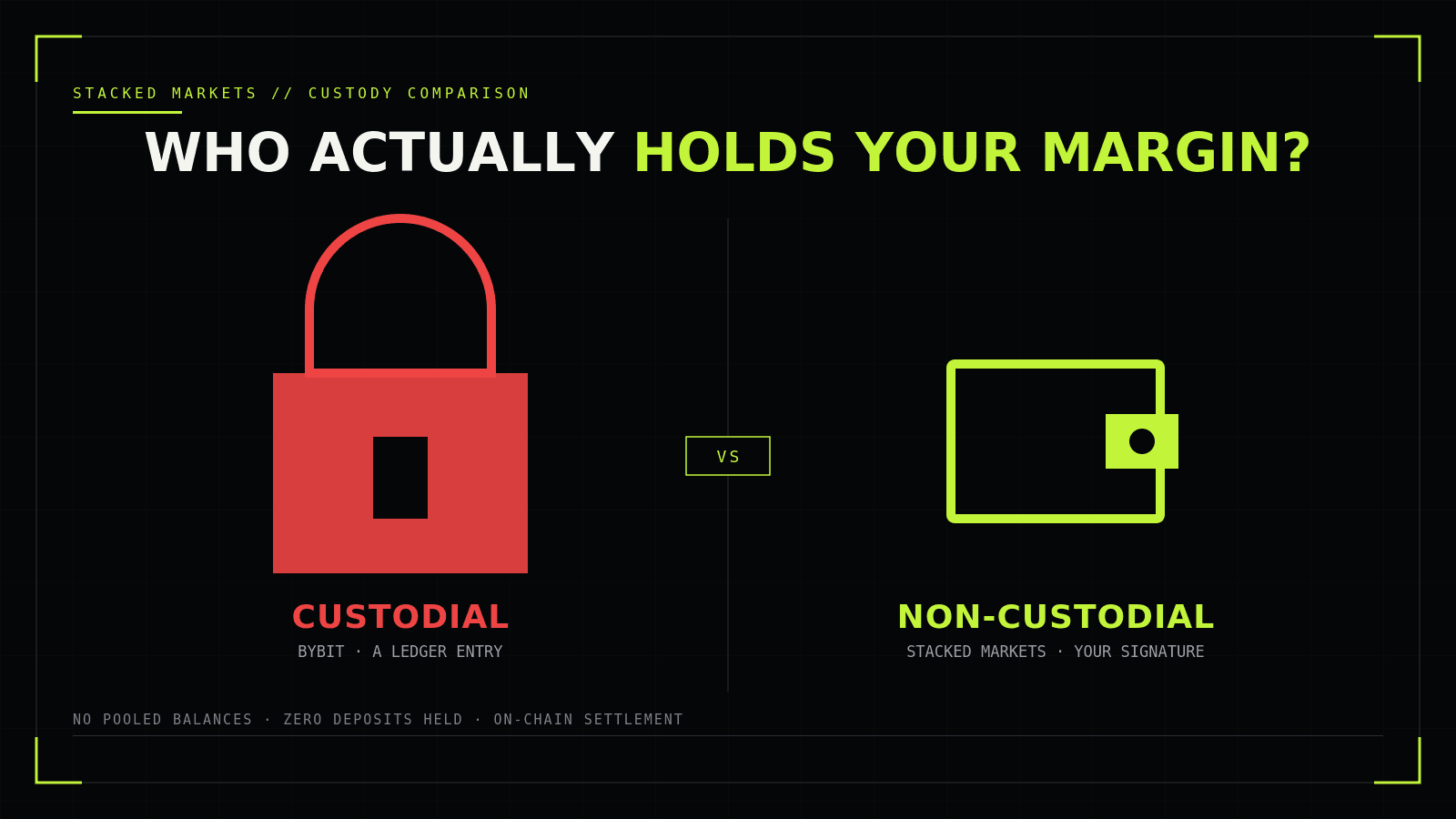
Bybit is a custodial exchange. When you deposit USDC or any other asset, you hand it to Bybit. You receive a balance entry in their internal ledger. You do not hold the asset. You hold a claim.
That claim is only as good as Bybit's operational continuity, their solvency, and their willingness to process your withdrawal when you need it. Under normal conditions, those three things align. Under stress - a regulatory freeze, a liquidity crunch, a security incident, a technical failure - they can decouple fast.
The February 2025 Bybit exploit is the clearest evidence of what custodial risk looks like at scale. Attackers drained USD 1.5 billion from a cold wallet through a compromised Safe multisig interface - the largest single crypto theft on record. Bybit covered the losses and kept operating, which is the best-case outcome for a custodial incident of that magnitude. The point isn't that Bybit failed its users permanently. The point is that the risk was real, concentrated, and entirely outside your control.
No on-chain proof of ownership. No ability to move your funds independently. Just a support ticket.
The cost that doesn't show up in the fee comparison
Most comparisons between custodial and non-custodial venues focus on trading fees, spread, and liquidity depth. Those numbers are real. Bybit's maker fees run as low as 0.01% at high volume tiers, and the liquidity on major pairs is deep. That's a genuine advantage.
But the fee comparison doesn't price in counterparty risk. It doesn't price in the hours or days you might spend unable to exit a position because withdrawals are paused. It doesn't price in the regulatory exposure of having your KYC data and balance history sitting on a centralised server in a jurisdiction that may not align with yours.
The cost of a withdrawal freeze during a volatile session isn't a basis point. It's the entire position.
Custody risk is a tail event. Tail events define outcomes. If you're trading with meaningful size, the expected value of that tail matters more than a 0.02% difference in taker fees.
What non-custodial trading changes - and what it doesn't
Non-custodial perpetual futures trading on Hyperliquid, accessed through an interface like Stacked Markets, changes one thing specifically: who holds your collateral. Your margin sits in a smart contract tied to your wallet address. No exchange can freeze it. No support team controls access. You sign each action with your own keys.
That's the core protection. It's also the full extent of what non-custodial architecture solves.
It does not eliminate liquidation risk. It does not eliminate smart contract risk. It does not eliminate the risk of a bad trade. If Hyperliquid's protocol has a vulnerability, your funds in that protocol are exposed. The February 2026 Hyperliquid validator incident - which briefly caused settlement delays across several perpetual pairs - showed that on-chain systems carry their own failure modes. The difference is that those failure modes are visible on-chain, auditable, and not controlled by a single corporate entity making decisions behind closed doors.
Non-custodial is necessary. It's nowhere near sufficient on its own. But for active traders who already understand the mechanics, it removes the single largest concentration of counterparty risk in the stack.
The honest trade-off
Bybit offers deeper liquidity on some pairs, a broader product suite, and tighter spreads at high volume. Those are real. If you're trading obscure altcoin perps with thin on-chain books, Bybit may be the only viable venue.
What Bybit cannot offer is verifiable on-chain custody. Your balance is a ledger entry. Your withdrawal is a permission. Both can be revoked under circumstances you don't control.
Stacked Markets routes orders to Hyperliquid's on-chain CLOB. You never deposit funds with Stacked Markets. The interface holds no keys and pools no collateral. You approve each action through your wallet. If Stacked Markets went offline tomorrow, your positions and margin on Hyperliquid would be completely unaffected - accessible directly through any other interface.
That's a structurally different risk profile. Not a marketing claim. A verifiable architectural fact.
The honest trade-off is this: you pay for non-custodial access with some liquidity depth and some product breadth. You get back the one thing a custodial exchange cannot give you - unilateral control over your own funds.
Five questions to answer before your next trade
- Where does your margin actually sit? If the answer is "on the exchange," you are an unsecured creditor. Know that going in.
- What happens to your open positions if the venue pauses withdrawals? On a custodial exchange, you may be unable to close or transfer. On Hyperliquid, your positions remain accessible through any interface.
- Have you verified your balance on-chain? If you can't point to a wallet address and a smart contract balance, you don't have on-chain custody. You have a promise.
- What is your exposure if the venue's hot wallet is compromised? The February 2025 Bybit incident involved USD 1.5 billion. Bybit absorbed it. The next exchange to face a comparable incident may not.
- Is the liquidity advantage worth the custody risk at your current position size? At small size, fee and liquidity differences dominate. At meaningful size, the tail risk of a custody event changes the expected value calculation entirely.
Connect your wallet in testnet mode and run through order flow before committing real capital. The network badge stays visible so you always know which environment you're in.
FAQs
What is the main custody difference between Stacked Markets and Bybit?
Bybit holds your funds in its own wallets. You hold a balance entry, not the asset itself. Stacked Markets holds nothing. Your margin sits in a Hyperliquid smart contract tied to your wallet address. Stacked Markets cannot move your funds under any circumstances.
Does trading on Stacked Markets eliminate all risk?
No. Smart contract risk, protocol risk, liquidation risk, and bridge risk all remain. Non-custodial architecture removes counterparty custody risk - the risk that an exchange freezes, misappropriates, or loses your funds. It does not remove the other categories.
What happened to Bybit users during the February 2025 exploit?
Bybit suffered a USD 1.5 billion cold wallet drain via a compromised Safe multisig interface. Bybit covered the losses and continued operating. Withdrawals remained functional for most users. The incident demonstrated that custodial risk is real and concentrated, even at a well-capitalised exchange.
Can I access my Hyperliquid positions if Stacked Markets goes offline?
Yes. Your positions and margin on Hyperliquid are tied to your wallet, not to Stacked Markets. If the Stacked Markets interface became unavailable, you would access your positions directly through Hyperliquid or any other compatible interface.
What is an agent wallet and does it create custody risk?
An agent wallet is an optional local signing key that speeds up order approvals. It stays in your browser and never reaches Stacked Markets' servers. You can revoke it at any time. It does not give Stacked Markets custody of your funds.
Is Hyperliquid's on-chain CLOB actually liquid enough for serious trading?
Hyperliquid has become one of the highest-volume on-chain perpetual futures venues. Major pairs like BTC and ETH perps carry sufficient depth for most active traders. Liquidity on smaller altcoin pairs is thinner than on Bybit. That is the genuine trade-off.
How do I start trading on Stacked Markets without mainnet risk?
Connect your wallet in testnet mode. The terminal layout is identical to mainnet. Fund with test assets and run through order flow before committing real capital. The network badge in the header stays visible so you always know which environment you're in.