
Stacked Markets
Who Is Stacked Markets For? A Beginner vs. Advanced Trader Breakdown
Published Jul 4, 2026 · By Stacked Markets Research Team
Contents
- The short answer
- What Stacked Markets actually is
- The trader profile this terminal is built for
- What beginners need to know before using it
- What intermediate and advanced traders get from it
- Who Stacked Markets is probably not right for (yet)
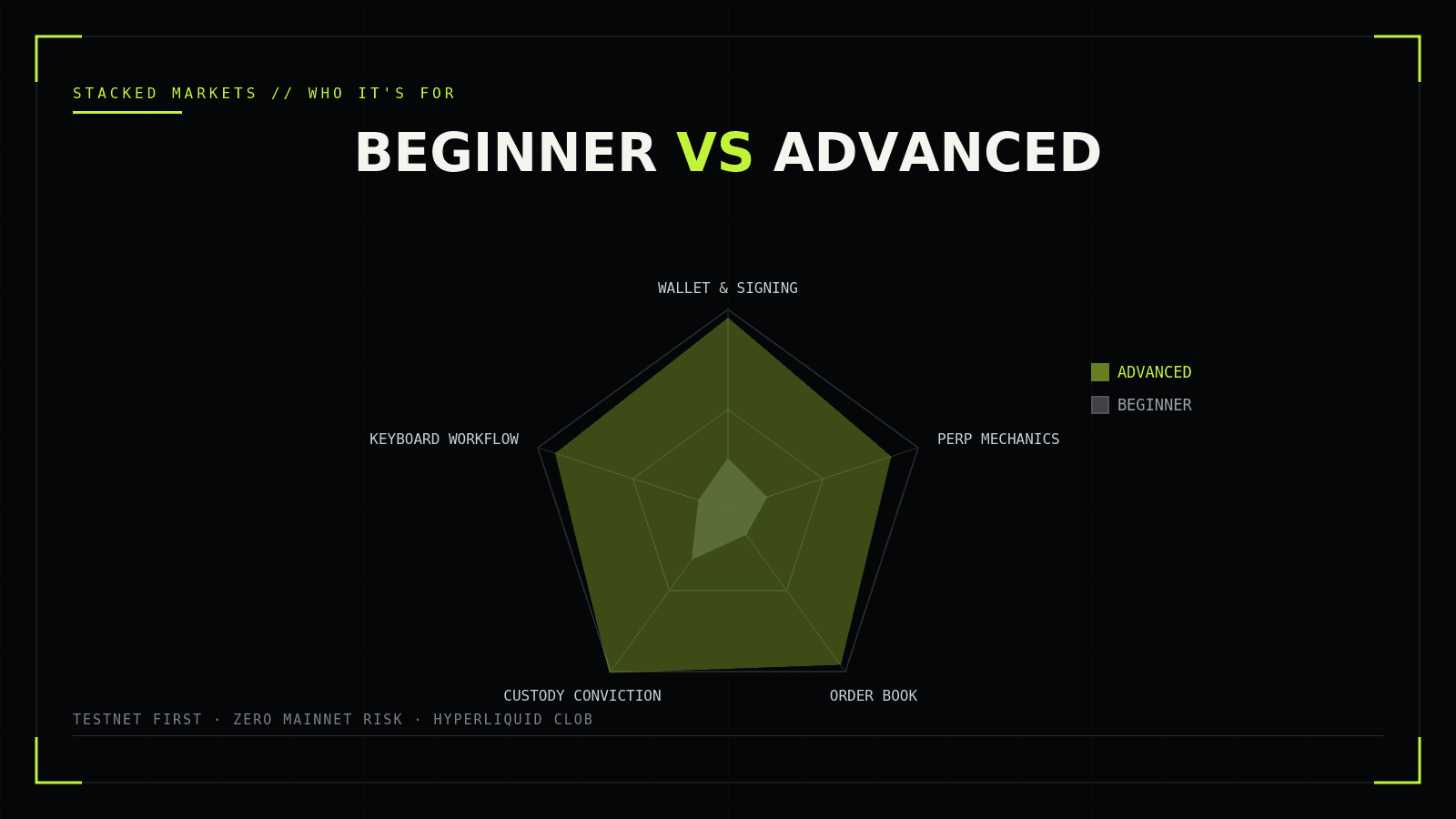
- Comparing the fit: beginner vs. advanced at a glance
- Risk caveat
- FAQs
The short answer
Stacked Markets is built for active perpetual futures traders who already understand wallets, order books, and position management, and who are tired of choosing between execution quality and custody of their funds.
If you are new to crypto, new to perps, or have never connected a wallet to a DeFi protocol, this terminal will feel steep. That is not a knock on you. It is honest framing. The tool assumes a baseline that takes time to build.
If you are an intermediate or advanced perp trader who has been using Hyperliquid's native UI, dYdX, or a centralized exchange, and you want professional-grade execution without handing over your collateral, Stacked Markets is worth your attention.
What Stacked Markets actually is
Stacked Markets is a non-custodial trading terminal for perpetual futures. It routes orders through Hyperliquid's on-chain central limit order book. You connect an Ethereum wallet, link a signer address, and trade directly. Your collateral is never pooled. Your keys never leave your control. Hyperliquid handles matching, margin, and settlement. Stacked Markets is the interface and execution layer sitting in front of that infrastructure. The terminal holds nothing. Every funding rate and PnL figure is verifiable on-chain.
The terminal is currently live on testnet at testnet.stackedmarkets.com. Mainnet pricing has not been announced. Orders are submitted as IOC-style slippage-bounded limit orders — the order either fills within your specified slippage tolerance or it does not fill at all. There are no fake market orders executing at arbitrary prices.
The trader profile this terminal is built for
The ideal customer for Stacked Markets is specific. Not a casual crypto user. Not someone looking for a simple swap interface. The target trader:
- Trades perpetual futures daily or weekly
- Is comfortable connecting a wallet and signing transactions
- Reads order books and thinks in terms of position sizing, entry price, and funding
- Has probably used Hyperliquid's native UI or dYdX at some point
- Distrusts custodial platforms, particularly after the exchange collapses of recent years
- Wants professional tooling without the custody risk that comes with centralized venues
That profile skews 25 to 40. Active on crypto Twitter/X and in trading Discord communities. Follows Hyperliquid closely. Responds to technical explanations, not marketing copy.
What beginners need to know before using it
Prerequisites that matter
Stacked Markets does not have an onboarding flow designed for someone new to DeFi. That is a deliberate product choice, not an oversight. The terminal is optimized for speed and precision, not hand-holding. To use it effectively, you need to be comfortable with:
- Wallets and signing. You connect an Ethereum wallet (MetaMask or any EOA-compatible wallet) and link a signer address. Every trade requires an explicit wallet approval with a plain-language signing prompt. The testnet is the right place to work through it — zero mainnet risk.
- Perpetual futures mechanics. Perps have funding rates, liquidation prices, and margin requirements. If you do not already understand how a funding rate works, or what cross-margin versus isolated margin means, build that foundation before trading with real capital.
- Order book reading. The terminal surfaces a live order book. If you have only ever used market orders on a spot exchange, the order book view will require some adjustment. Understanding bid/ask spread, depth, and how limit orders interact with the book is baseline knowledge for using this tool well.
- Hyperliquid's ecosystem. Since Stacked Markets routes through Hyperliquid's on-chain CLOB, knowing how Hyperliquid works, its fee structure (approximately 0.01% maker rebate and 0.035% taker at standard tier), and its margin model will help you trade with fewer surprises.
The learning curve, honestly
If you have the prerequisites above, the terminal itself is manageable. The UI is direct. The order ticket is clear. The signing prompts use plain language. The harder part is not the interface. It is the underlying knowledge of perp mechanics and on-chain execution that takes time to build. Stacked Markets does not abstract that away, and it is not trying to. Start on testnet. You can test the full execution workspace with zero mainnet risk. Spend time there before committing capital.
What intermediate and advanced traders get from it
Execution quality without custody risk
This is the core tradeoff Stacked Markets resolves. On centralized exchanges, you get professional tooling but hand over your collateral. On most DEXs, you keep custody but sacrifice execution quality. Stacked Markets is built to close that gap. Your collateral stays in your wallet. The terminal never pools it. Hyperliquid's on-chain CLOB handles matching. You get order book depth, real limit orders, and on-chain settlement — without a custodial counterparty holding your funds.
Order transparency that most DEXs skip
Most DEX interfaces submit something that looks like a market order but is actually a tolerance-bounded swap with opaque execution. Stacked Markets submits IOC-style slippage-bounded limit orders. You set the slippage tolerance. The order fills within that range or it does not fill. Nothing executes at a price you did not approve, and the signing prompt shows you exactly what you are approving before anything happens. The UI also surfaces freshness and connection-state indicators. If the data feed goes stale, you see it before it affects your execution.
Keyboard-first workflow
Advanced traders think in keystrokes, not clicks. Stacked Markets has keyboard-first workflows built in for speed and precision. When you are managing a position in a fast-moving market, the difference between a keyboard shortcut and three mouse clicks is real.
Planned features worth knowing about
Vault-style automation (planned). The planned automation layer will allow rule-based execution with hard risk caps, drawdown halts, and cancel-all hooks. The risk controls are being built in from the start, not bolted on later. This is relevant for traders who want to automate parts of their strategy without giving up custody or accepting uncapped downside.
Copy-trading with hard risk caps (planned). Non-custodial copy-trading for on-chain perps does not currently exist in any meaningful form. The planned implementation includes drawdown halts and cancel-all hooks. It is not live. If you are evaluating the product today, that needs to be stated clearly.
Who Stacked Markets is probably not right for (yet)
Being honest about fit matters more than trying to appeal to everyone.
- Traders new to crypto or DeFi. If you are still learning how wallets work or what a perp is, start with educational resources and simpler interfaces first. Come back when you have the foundation.
- Passive or low-frequency traders. If you trade once a month or want a set-and-forget product, the terminal is more than you need right now. The planned automation features may change this, but they are not live yet.
- Traders who prefer AMM-style simplicity. If you want one-click swaps and have no interest in order books or limit order mechanics, this is not the right interface. That is a valid preference. It is just a different product category.
- Traders who need a mobile-first experience. The terminal is keyboard-first and workspace-oriented, built for desktop. If you primarily trade from your phone, the experience will be suboptimal.
Comparing the fit: beginner vs. advanced at a glance
| Criteria | Beginner | Intermediate / Advanced |
|---|---|---|
| Wallet and signing familiarity | Needs to build this first | Already comfortable |
| Perp mechanics knowledge | Needs foundation first | Solid baseline |
| Order book reading | Unfamiliar | Reads it daily |
| Custody preference | May not have strong view yet | Strongly prefers non-custodial |
| Execution transparency needs | Not yet a priority | High priority |
| Keyboard workflow value | Low | High |
| Testnet as starting point | Yes, after building basics | Yes, immediately |
| Fit today | Not yet | Strong |
Risk caveat
Perpetual futures trading carries significant risk. Leverage amplifies both gains and losses. Liquidations happen fast. On-chain execution does not protect you from bad trades, only from a custodial counterparty holding your funds. Trade only what you can afford to lose, and understand your liquidation price before entering any position.
FAQs
Who is Stacked Markets designed for?
Active perpetual futures traders, intermediate to advanced, who want professional-grade execution tooling without giving up custody of their collateral. The target user already understands wallets, order books, and perp mechanics.
Can a beginner use Stacked Markets?
Not effectively without building some foundation first. You need to understand how wallets and transaction signing work, how perpetual futures mechanics operate, and how to read an order book. The testnet is a good place to learn the interface once you have that baseline.
Does Stacked Markets hold my funds?
No. Stacked Markets is the interface and execution layer. Hyperliquid handles matching, margin, and settlement. Your collateral stays in your wallet. The terminal never pools it.
What makes Stacked Markets different from Hyperliquid's native UI?
Stacked Markets routes through Hyperliquid's own order book and fee structure, so you access the same liquidity. The difference is the interface: keyboard-first workflows, IOC-style slippage-bounded limit orders with explicit signing prompts, freshness indicators, and a planned automation and copy-trading layer that Hyperliquid's native UI does not offer.
Are automation and copy-trading features available now?
No. Vault-style automation and copy-trading are planned features, not live ones. They are in development with hard risk caps, drawdown halts, and cancel-all hooks built in. The current terminal is the execution workspace: order book, chart, positions, and order ticket.
What fees does Stacked Markets charge?
Stacked Markets users access Hyperliquid's native fee structure directly, approximately 0.01% maker rebate and 0.035% taker at standard tier. No platform fee for Stacked Markets has been announced yet.
Is Stacked Markets on mainnet?
The terminal is currently live on testnet at testnet.stackedmarkets.com. Mainnet has not launched yet and mainnet pricing has not been announced.
Ready to test it? If you are an active perp trader who wants non-custodial execution with professional tooling, the testnet is the right next step. Full execution workspace, zero mainnet risk.